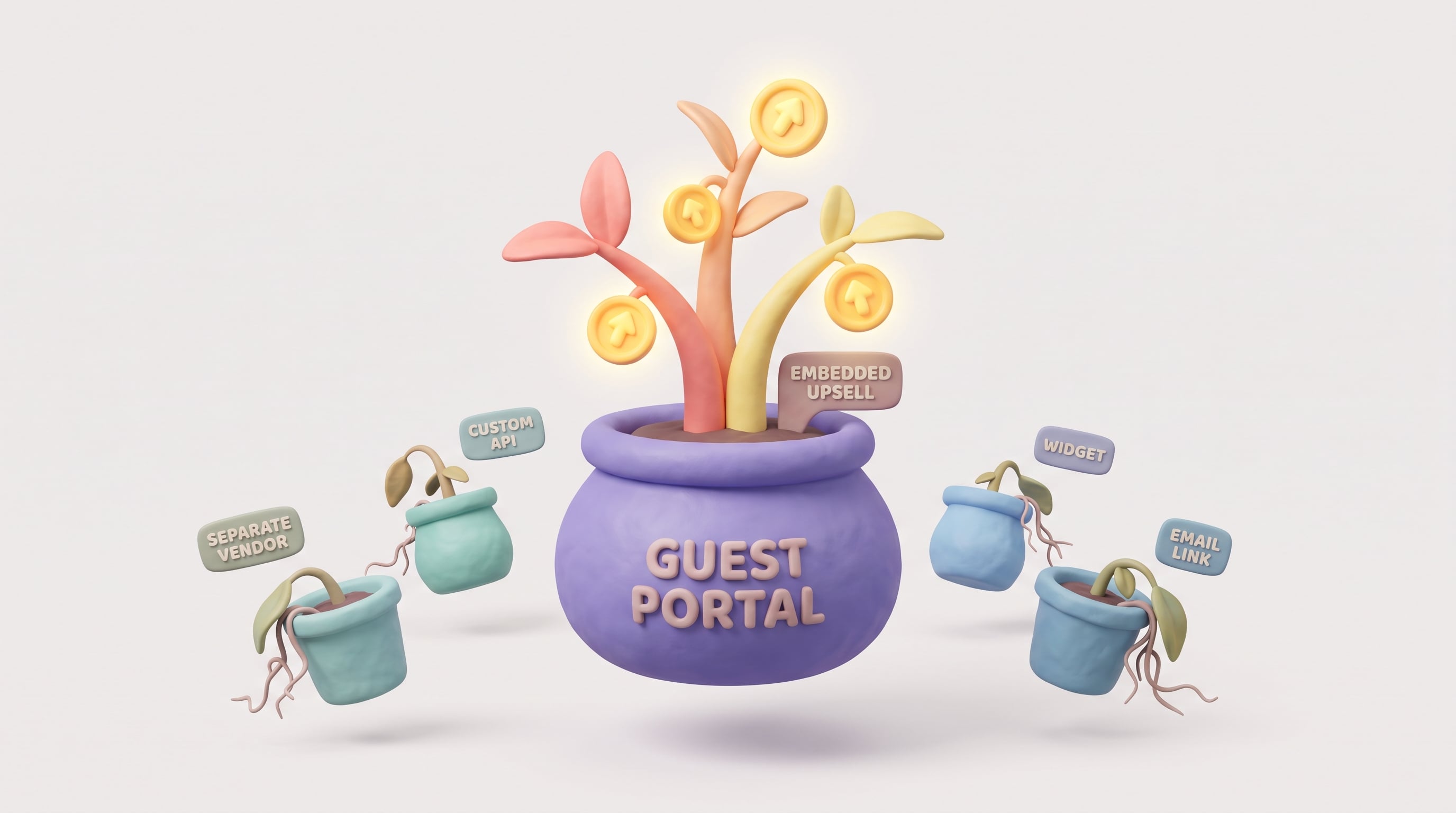

En bref : L'automatisation des locations de vacances consiste à utiliser des logiciels connectés pour gérer la vérification des voyageurs, les codes d'accès, les plannings de ménage, l'exécution des ventes croisées et la surveillance du bruit ou de l'occupation sans intervention manuelle d'une équipe opérationnelle. En 2026, le point de départ le plus stratégique est d'automatiser le parcours d'enregistrement numérique avec SuitePortal, car c'est le point de contact garanti où chaque voyageur interagit avec votre marque avant son arrivée, ce qui en fait l'endroit idéal pour générer des revenus et déclencher des tâches opérationnelles en même temps.
Que signifie réellement l'automatisation des locations de vacances ?
L'automatisation des locations de vacances est la pratique qui consiste à connecter les logiciels et le matériel de votre exploitation (système de gestion immobilière, serrures connectées, capteurs de bruit, traitement des paiements et gestion des tâches) afin que les actions se déclenchent mutuellement sans qu'un humain n'ait à transmettre manuellement les informations. Un voyageur termine sa vérification et un code de serrure s'active. Un voyageur achète une option et une tâche de ménage est créée. Un capteur détecte un pic d'occupation et une alerte est émise avant même qu'une plainte ne soit déposée.
Ce terme est utilisé de manière générale dans l'industrie pour désigner tout, d'un chatbot répondant à des FAQ à la tarification dynamique par IA. Pour un gestionnaire professionnel gérant des dizaines ou des centaines de biens, la définition pertinente est plus précise : l'automatisation est tout flux de travail qui nécessitait auparavant qu'une personne ouvre deux systèmes, copie des informations de l'un à l'autre et fasse un suivi pour confirmer que cela a été fait, et qui se déroule désormais instantanément avec un journalisation automatique.
Cette distinction est importante car le marché est actuellement fragmenté. La plupart des gestionnaires utilisent encore un ensemble d'outils déconnectés, et le responsable des opérations devient le lien humain qui maintient le tout, saisissant manuellement les données d'un système à l'autre et cherchant des confirmations. Ce coût de main-d'œuvre augmente de manière linéaire avec le nombre de logements, tandis que les flux de travail automatisés évoluent à un coût marginal proche de zéro par propriété supplémentaire.
Pourquoi l'automatisation devient-elle indispensable pour les gestionnaires de locations courte durée en 2026 ?
Trois forces convergent pour rendre les opérations manuelles intenables à grande échelle.
Premièrement, les structures de frais des OTA continuent de comprimer les marges brutes. Le modèle tarifaire standard d'Airbnb s'élève désormais à 15,5 % pour la plupart des hôtes, déduit directement du versement, selon la documentation officielle d'Airbnb sur les frais. Lorsque 15 % ou plus de chaque réservation disparaît avant d'atteindre votre compte, les revenus annexes et l'efficacité opérationnelle deviennent les deux seuls leviers que vous maîtrisez totalement.
Deuxièmement, la croissance de l'offre se stabilise mais continue de créer une pression concurrentielle sur la plupart des marchés. Les perspectives d'AirDNA pour la mi-2026 aux États-Unis ont revu la croissance de l'offre à la baisse, à environ 2,7 % pour l'année, bien en dessous de l'expansion à deux chiffres observée en 2021 et 2022, avec un RevPAR prévu en modeste hausse alors que le ralentissement des nouvelles annonces soutient l'occupation des gestionnaires établis. Cela signifie que les gestionnaires qui réussiront en 2026 sont ceux qui extrairont plus de valeur par logement existant, et non ceux qui se contentent d'ajouter des biens.
Troisièmement, les exigences de conformité locale deviennent plus spécifiques et plus automatisables par nature. Les villes intègrent de plus en plus la technologie de surveillance directement dans les lois sur les permis. L'ordonnance sur les locations de vacances de South Lake Tahoe, par exemple, exige une surveillance du bruit intérieur en temps réel afin que les gestionnaires immobiliers puissent répondre aux problèmes potentiels de nuisances 24h/24 et 7j/7, la ville définissant explicitement l'objectif comme la prévention des perturbations avant que les voisins ne soient affectés, selon la page officielle de l'ordonnance de la ville de South Lake Tahoe. La conformité manuelle et surveillée par l'homme ne peut tout simplement pas répondre à une exigence de réponse 24h/24 et 7j/7 pour un portefeuille multicompte.
Quelles sont les catégories clés d'automatisation dont chaque gestionnaire a besoin ?
L'automatisation des locations de vacances n'est pas une simple fonctionnalité. C'est un ensemble de catégories connectées qui résolvent chacune un goulet d'étranglement opérationnel spécifique. Les gestionnaires professionnels automatisent généralement dans cet ordre de priorité.
Vérification des voyageurs et accès
SuiteVerify automatise la vérification d'identité, les dépôts de garantie et la signature du contrat de location avant qu'un voyageur n'arrive chez vous. Associé à SuiteConnect, les voyageurs vérifiés reçoivent un code de serrure connecté spécifique à leur réservation qui s'active et se désactive automatiquement pendant la période de séjour, éliminant à la fois la tâche manuelle de réinitialisation des codes et les risques de sécurité liés aux codes périmés. Pour un aperçu plus approfondi de la manière dont cela s'associe au matériel, consultez notre guide sur les logiciels de location de vacances avec intégration de serrures connectées.
Automatisation des revenus et des ventes croisées
SuitePortal saisit l'intention de voyage lors du processus d'enregistrement (anniversaire, voyage d'affaires, réunion de famille) et propose des ventes croisées pertinentes en un clic au moment exact où les voyageurs sont le plus engagés. Les achats sont acheminés directement vers les tâches d'exécution, comblant l'écart entre la vente et la livraison physique de l'article dans le logement.
Ménage et automatisation des tâches
SuiteKeeper génère automatiquement les tâches de rotation et d'exécution à partir des déclencheurs de réservation, les attribue au bon prestataire et exige une vérification photo pour le contrôle qualité. Aucun gestionnaire n'a besoin d'envoyer un SMS à un agent d'entretien pour confirmer qu'une intervention a eu lieu.
Surveillance du bruit et de l'occupation
SuiteMonitor suit les niveaux de décibels et l'occupation en temps réel sans enregistrer de sons ni de vidéos, respectant à la fois les règles de confidentialité des plateformes et la vague croissante d'ordonnances municipales qui exigent ce type de surveillance pour le renouvellement des permis.
Communication avec les voyageurs
SuiteOp automatise les messages répétitifs aux voyageurs, les instructions d'avant-arrivée et les suivis en cours de séjour sur tous les canaux, tout en acheminant vers votre équipe tout ce qui nécessite un jugement humain (un litige, une demande de remboursement, une urgence). C'est la fonctionnalité au niveau de la plateforme qui relie les résultats destinés aux voyageurs de chaque autre module.
Comment gagner plus d'argent grâce aux ventes croisées en location de vacances ?
L'automatisation des ventes croisées reste l'un des gains les plus rapides et les plus maîtrisables d'une stratégie d'automatisation plus large, car elle compense directement la compression des commissions des OTA sans nécessitée d'augmentation des tarifs.
Le mécanisme : au lieu de s'en remettre à des messages génériques mal chronométrés sur la messagerie des OTA (que les voyageurs ignorent massivement lorsqu'ils gèrent leurs vols et leurs valises), déplacez l'offre dans le flux d'enregistrement numérique obligatoire. Cela garantit un taux de visionnage de 100 % et place l'offre sous les yeux d'un voyageur qui prépare activement son séjour et est psychologiquement disposé à dépenser pour son confort.
Faire correspondre l'offre à l'intention du voyage est ce qui différencie un programme qui convertit d'un programme qui est ignoré. Un voyageur d'affaires devrait voir une connexion Wi-Fi haut débit ou un ménage en milieu de séjour, et non un forfait romantique. Une famille devrait voir un service de livraison de courses ou de location d'équipement. Un couple célébrant un anniversaire devrait voir un forfait de célébration. Pour une analyse complète de la façon dont cela fonctionne spécifiquement sur le canal Airbnb, consultez notre guide sur l'automatisation des revenus annexes sur Airbnb à grande échelle,
Principales ventes croisées expérientielles pour 2026
- Forfaits de célébration : Fleurs, vin et pâtisseries pour les anniversaires, mariages et lunes de miel. Valeur perçue élevée, forte marge.
- Approvisionnement culinaire local : Kits d'arrivée sélectionnés auprès de fournisseurs locaux plutôt qu'une livraison de courses générique. Consultez notre guide dédié sur l'automatisation des ventes croisées de livraison de courses.
- Ménages premium en milieu de séjour : Très demandés pour les séjours de cinq nuits ou plus et souvent sous-monétisés. Tous les détails dans comment gagner plus d'argent grâce aux demandes en milieu de séjour.
- Location d'équipements : Chaises de plage, vélos, matériel pour bébés. Coût marginal de réalisation presque nul après l'achat initial.
- Départ tardif : Simple, à fort taux de conversion et directement lié à l'automatisation des serrures connectées. Voir l'automatisation des ventes croisées de départs tardifs pour en comprendre les mécanismes.
Impact mensuel sur les revenus par propriété (à titre indicatif)
- Forfait de célébration (150 $) : 2 ventes par mois = 300 $
- Ménage premium en milieu de séjour (120 $) : 1 vente par mois = 120 $
- Approvisionnement culinaire local (100 $) : 1 vente par mois = 100 $
- Location d'équipement (75 $) : 1 vente par mois = 75 $
- Augmentation mensuelle totale : 595 $ par logement
Pour un portefeuille de 50 logements, ce modèle de conversion modeste se traduit par une source significative de revenus annexes annuels. Comme l'exécution est automatisée plutôt que coordonnée manuellement, la marge de ces revenus va presque entièrement aux bénéfices nets. Si vous souhaitez obtenir une ventilation par catégorie d'autres types de revenus sous-utilisés, notre article sur les revenus annexes non basés sur le temps aborde des offres allant au-delà des classiques arrivées anticipées et départs tardifs.
Comment fonctionne la prévention automatisée du bruit et des fêtes ?
Alors que les exploitants s'orientent de plus en plus vers les ventes croisées automatisées et la réservation directe, la protection de la propriété physique devient aussi importante que sa monétisation. C'est là que l'automatisation du bruit et de l'occupation prend toute sa valeur.
L'orientation réglementaire est claire. Au-delà de South Lake Tahoe, des villes comme Palm Springs et Fort Lauderdale ont intégré des exigences de surveillance des décibels directement dans les règles d'autorisation des locations de courte durée, précisant généralement que les appareils mesurent uniquement les niveaux sonores et n'enregistrent pas l'audio, conformément à la politique d'Airbnb selon laquelle les moniteurs de bruit intérieurs ne sont autorisés qu'à condition d'être signalés et jamais placés dans les chambres ou les salles de bains, selon le guide du centre d'aide d'Airbnb.
SuiteMonitor automatise cette obligation de conformité tout en servant d'outil de prévention des fêtes. Il envoie des alertes progressives dès que les seuils de décibels ou d'occupation sont franchis, permettant à votre équipe d'intervenir avant qu'un rassemblement ne devienne une infraction. Pour connaître toute la logique d'escalade, consultez comment automatiser la résolution du bruit en location courte durée grâce aux capteurs IoT, et pour les bases juridiques sous-jacentes, notre guide sur la prévention des fêtes non autorisées grâce au filtrage automatisé des voyageurs.
Opérations manuelles vs. Opérations automatisées
La différence pratique entre une pile opérationnelle manuelle et une pile connectée et automatisée se manifeste à chaque étape du parcours du voyageur.
- Vérification des voyageurs : Examen manuel des photos de pièces d'identité dans un tableur ou un fil de messagerie, par opposition à la correspondance biométrique automatisée et à l'approbation instantanée via SuiteVerify.
- Codes d'accès : Un membre du personnel qui se connecte à l'application d'un fournisseur de serrures pour configurer ou réinitialiser manuellement un code, par opposition à SuiteConnect qui génère et fait expirer automatiquement des codes liés à la période de réservation.
- Exécution des ventes croisées : Un gestionnaire qui envoie un SMS à un agent d'entretien en espérant que la demande sera mémorisée, par opposition à une tâche traçable dans SuiteKeeper exigeant une vérification photo avant qu'elle ne soit marquée comme terminée.
- Réponse au bruit : Attendre la plainte d'un voisin, par opposition à une alerte de décibels en temps réel provenant de SuiteMonitor qui déclenche automatiquement des avertissements progressifs pour le voyageur.
- Communication avec les voyageurs : Modèles copier-collés envoyés manuellement, par opposition à des réponses automatisées et contextuelles qui ne font appel à l'humain que lorsque le jugement est nécessaire.
Chaque ligne de cette liste représente un point où un processus manuel dépend d'une personne spécifique qui doit se souvenir de faire une chose spécifique, à un moment précis, sans faillir, pour chaque logement du portefeuille. L'automatisation supprime totalement cette dépendance à la mémoire.
Comment les gestionnaires professionnels déploient-ils l'automatisation à grande échelle ?
Les gestionnaires gérant de 10 à plus de 500 logements n'automatisent pas tout en même temps. La séquence qui fonctionne en pratique ressemble à ceci.
- Commencez par la vérification et l'accès. C'est le processus manuel présentant le plus de risques et de frictions (exposition à la fraude, remises de clés, blocages) et le plus facile à automatiser entièrement en premier avec SuiteVerify et SuiteConnect.
- Intégrez l'automatisation des tâches pour le ménage. Chaque réservation doit générer automatiquement sa tâche de rotation sans planification manuelle, en utilisant SuiteKeeper.
- Ajoutez l'automatisation des revenus une fois que les opérations sont stables. Les ventes croisées ne se convertissent de manière fiable qu'une fois que l'exécution est déjà automatisée ; vendre un forfait champagne avant de pouvoir garantir la livraison ne fait que créer un risque de remboursement.
- Mettez en place la surveillance de la conformité. À mesure que les portefeuilles s'étendent à différentes juridictions, SuiteMonitor uniformise la conformité en matière de bruit et d'occupation, peu importe le nombre d'ordonnances municipales applicables.
- Consolidez votre stack technologique. Chaque outil tiers supplémentaire ajoute une intégration à maintenir et un risque de perte de données. Notre guide complet sur les logiciels pour portefeuilles multi-logements explique comment auditer et consolider un stack technologique existant sans perturber les opérations en cours.
Cette séquence est cruciale, car une automatisation qui n'est pas opérationnellement fiable crée plus de travail qu'elle n'en épargne. Un voyageur qui achète une option qui n'est jamais fournie, ou un code de serrure qui ne se désactive pas, génère un ticket de support et un remboursement, et non un gain de revenus. Automatiser dans le mauvais ordre accroît les risques au lieu de les réduire.
Que dois-je automatiser en premier dans un petit portefeuille ?
Pour les gestionnaires ayant moins de 20 logements, la vérification des voyageurs et l'accès par serrure connectée offrent généralement la réduction la plus rapide de la charge de travail manuelle par heure investie, car la logistique d'enregistrement est généralement la plus grande source de perte de temps récurrente pour une petite équipe. L'automatisation des ventes croisées vaut la peine d'être ajoutée une fois que l'enregistrement est stable, car elle ne nécessite aucun effectif supplémentaire et compense directement les frais des OTA sur chaque réservation.
L'automatisation des locations de vacances remplace-t-elle le personnel de communication avec les voyageurs ?
Non. L'automatisation gère les communications répétitives et standardisées (instructions d'arrivée, mots de passe Wi-Fi, FAQ courantes) et achemine tout ce qui nécessite du jugement (réclamations, négociations de remboursement, urgences) vers un humain. L'objectif est de donner plus de valeur au temps de l'employé, et non de supprimer la supervision humaine dans les situations qui l'exigent. Notre guide sur l'automatisation de la communication avec les voyageurs sans perdre le contact humain explique précisément où doit se situer cette limite.
Mettez en œuvre votre stratégie d'automatisation dès aujourd'hui
La compression des marges des OTA, une croissance de l'offre plus lente mais toujours concurrentielle et le durcissement des exigences réglementaires municipales font des opérations manuelles basées sur des tableurs et des notes autocollantes un risque structurel pour l'avenir en 2026. Les gestionnaires qui prennent de l'avance sont ceux qui considèrent l'automatisation comme une infrastructure connectée (la vérification alimente l'accès, l'accès alimente les tâches, les tâches alimentent les revenus) plutôt que comme une collection d'outils déconnectés qui nécessitent encore une intervention humaine pour être assemblés.
Bâtir ce système connecté ne nécessite pas de supprimer votre système de gestion immobilière existant. Il faut une couche logicielle qui se superpose à celui-ci et automatise chaque action en aval. C'est le vide opérationnel que SuiteOp a pour mission de combler.
Voyez-le fonctionner sur vos propriétés
Une démo de 30 minutes avec notre équipe, sur les processus de votre propre portefeuille.
Questions fréquentes
- Comment puis-je augmenter les revenus de mes locations de vacances grâce aux ventes croisées sans alourdir la charge de travail manuelle ?
- La clé est d'automatiser les offres de ventes croisées directement dans votre parcours d'enregistrement numérique en utilisant une plateforme comme SuitePortal. Au lieu d'envoyer des messages génériques via les boîtes de réception des OTA que les voyageurs ignorent, présentez des options d'achat visuelles en un clic pendant le processus de vérification obligatoire avant l'arrivée, moment où l'engagement est maximal. Capturez les données d'intention de voyage (anniversaire, fête, réunion de famille) pour déclencher automatiquement des offres pertinentes. Lorsqu'un voyageur achète un forfait expérientiel, SuiteKeeper génère instantanément des tâches d'exécution et les achemine vers votre équipe de ménage avec des exigences de vérification photo. Cela élimine toute coordination manuelle, recherche de factures et allers-retours de communication tout en générant 8 à 12 % de revenus supplémentaires par réservation.
- Quelles sont les ventes croisées les plus rentables pour les locations de vacances en 2026 ?
- Les cinq principales ventes croisées expérientielles à forte marge pour 2026 sont les forfaits de célébration (fleurs, champagne, pâtisseries pour les anniversaires avec des marges bénéficiaires de 60 %), l'approvisionnement culinaire local (kits d'arrivée sélectionnés comprenant des produits artisanaux de fournisseurs locaux), les nettoyages premium en milieu de séjour (linge frais et rangement pour les séjours de plus de cinq jours), les locations d'équipements numériques et physiques (chaises de plage, vélos, poussettes haut de gamme ou surclassement Internet haut débit) et les kits d'accueil pour animaux de compagnie (friandises locales et accessoires griffés). Ces offres répondent à la demande des voyageurs en matière de commodité et d'authenticité locale tout en nécessitant une charge opérationnelle minime lorsqu'elles sont automatisées via votre PMS.
- SuiteOp intègre-t-il automatiquement les paiements de ventes croisées à l'exécution opérationnelle ?
- Oui, SuiteOp crée une boucle fermée entre les achats des voyageurs et la livraison opérationnelle. Lorsqu'un voyageur effectue un achat en un clic dans SuitePortal, le paiement est capturé instantanément et en toute sécurité au sein de la même interface personnalisée. À ce moment précis, SuiteKeeper génère automatiquement une tâche d'exécution spécialisée et l'achemine directement vers votre personnel de terrain ou vos prestataires de ménage. L'agent d'entretien voit l'exigence exacte sur son appareil mobile, complète la mise en place conformément à vos procédures et vérifie la livraison grâce au téléchargement obligatoire d'une photo. Pour les achats sensibles au temps comme le départ tardif, SuiteConnect ajuste instantanément les horaires d'activation de la serrure connectée dès que l'achat est confirmé. Cela élimine l'écart entre la vente et l'exécution qui fait échouer la plupart des programmes de ventes croisées manuels.
- Combien de revenus supplémentaires puis-je générer grâce à l'automatisation des ventes croisées en location de vacances ?
- Une seule propriété réalisant en moyenne seulement cinq ventes croisées modestes par mois peut générer 7 140 $ de revenus annuels supplémentaires. Par exemple, deux forfaits de célébration à 150 $ chacun (300 $), un ménage en milieu de séjour à 120 $, un kit culinaire local à 100 $ et un kit d'accueil pour animaux à 75 $ totalisent 595 $ par mois et par logement. Pour un portefeuille de 50 logements, cela se traduit par plus de 357 000 $ de revenus annexes bruts par an. Les données de l'industrie montrent que les propriétés automatisant des forfaits thématiques ciblés constatent des taux de conversion entraînant des augmentations de revenus de 8 à 12 %, les principaux gestionnaires prévoyant que les ventes croisées automatisées représenteront jusqu'à 15 % de la valeur brute des réservations d'ici 2026. La friction opérationnelle étant gérée par logiciel, les marges bénéficiaires nettes sur ces revenus sont exceptionnellement élevées.
- Quel est le meilleur moment pour présenter des ventes croisées aux voyageurs de locations de vacances ?
- Le point d'intervention le plus efficace se situe pendant le parcours d'enregistrement numérique, et non par le biais de messages sur les OTA quelques jours avant l'arrivée. En intégrant les offres de ventes croisées directement dans le processus de vérification obligatoire avant l'arrivée, vous garantissez un taux de visionnage de 100 %. À ce moment précis, les voyageurs sont très engagés, planifient activement l'itinéraire de leur séjour et sont statistiquement beaucoup plus enclins à acheter des surclassements axés sur la commodité et l'expérience. Les voyageurs n'aiment pas qu'on leur vende des choses de force, mais ils veulent absolument acheter des commodités qui améliorent leurs vacances. Les expériences de vente au détail automatisées et proactives intégrées à l'enregistrement surpassent considérablement les stratégies de messagerie réactives que les voyageurs ignorent lorsqu'ils gèrent la logistique de leur vol et leurs valises. Le timing est le facteur le plus critique de la conversion.
- Comment puis-je éviter les erreurs d'exécution des ventes croisées qui entraînent de mauvais commentaires ?
- Les échecs d'exécution se produisent lorsque la coordination manuelle est défaillante entre la vente et la livraison. Lorsque les agents d'entretien oublient les articles achetés ou que les instructions de mise en place se perdent dans les messages texte, les avis négatifs qui en résultent annulent tout profit du programme. SuiteKeeper résout ce problème en générant automatiquement des tâches traçables dès qu'un achat est finalisé. Le personnel de terrain reçoit des notifications mobiles claires avec des exigences précises, la vérification photo obligatoire à la fin garantit le contrôle de la qualité, et les gestionnaires peuvent surveiller le statut de l'exécution en temps réel. Cette approche méthodique élimine l'erreur humaine qui gangrène la coordination basée sur des tableurs. De plus, la capture d'un paiement sécurisé via SuitePortal avant l'arrivée garantit l'engagement des voyageurs et réduit le risque de non-présentation pour les services haut de gamme, tandis que SuiteVerify prévient les achats frauduleux grâce à la vérification d'identité biométrique.