A short-term rental PMS (property management system) is the software that acts as the system of record for a vacation rental business: it holds your listings, reservations, rates, and availability, syncs them with booking channels like Airbnb and Vrbo, and coordinates guest messaging, housekeeping, and payments from one dashboard. Guesty, Hostaway, Lodgify, and OwnerRez are common examples. Automation tools like SuiteOp connect to your PMS rather than replacing it.
See it running on your propertiesBook a demo
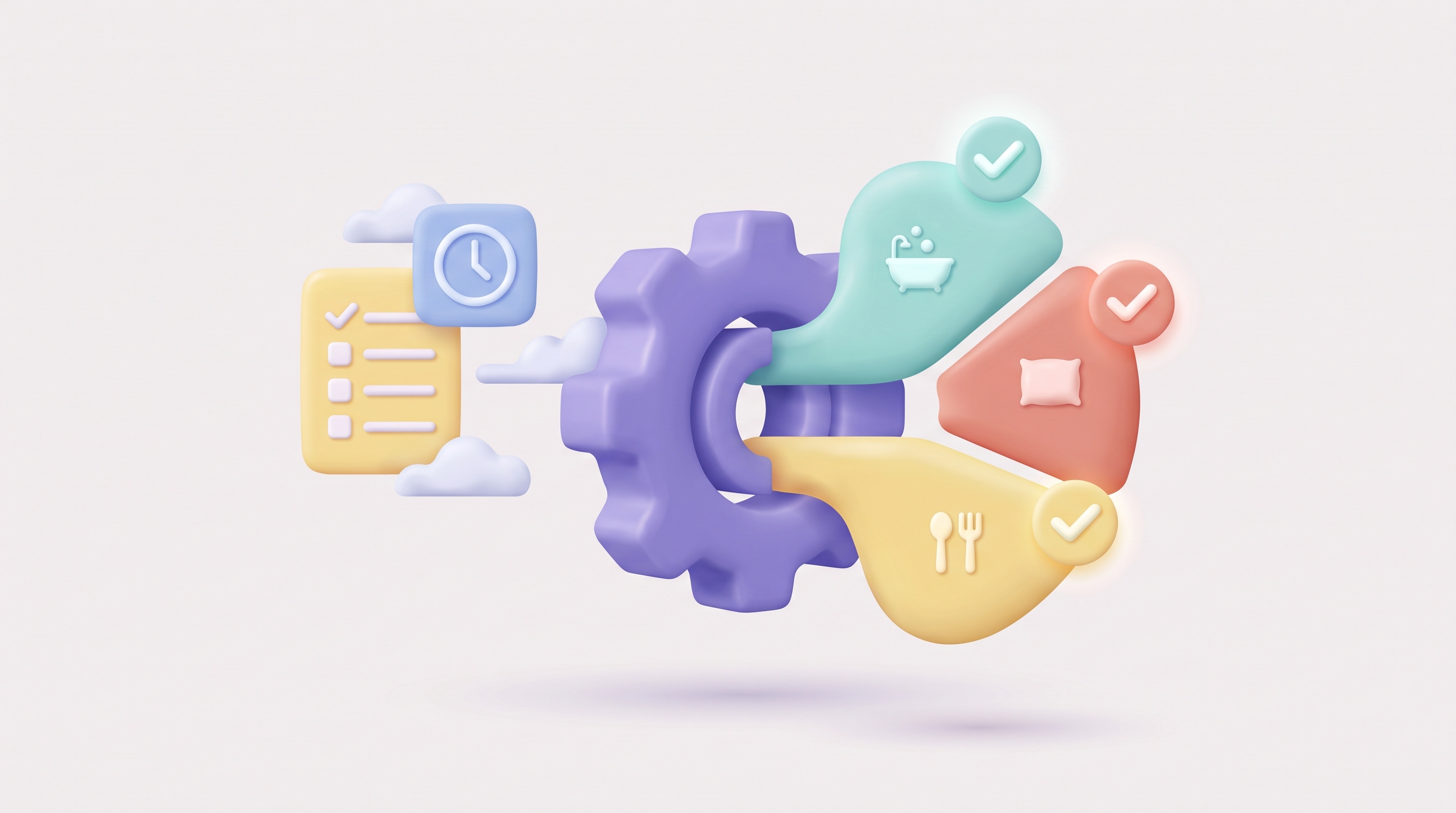
A single reservation can trigger work in four disconnected tools: the PMS holds the booking, a lock app generates the access code, a cleaning app assigns the turnover, and a screening tool verifies the guest, each with its own owner and no shared record connecting them. Underneath that sprawl are the same five jobs every short-term rental operator is running, whether they've named them or not: get the guest through the door, get the unit turned over, control access to it, verify who's actually staying in it, and capture the revenue sitting on the table beyond the nightly rate. What changed heading into 2026 is how much of that work operators expect software to handle without a human in the loop, and how clearly that work depends on a PMS connection to function at all.
The pressure behind that shift shows up in the data. Nearly half of operators, 47.8 percent, say more than half of their workflows are already automated, and 85.8 percent say technology now makes their job easier, according to data referenced in SuiteOp's own 2026 automation benchmarking. Staffing hasn't gotten any easier to manage either: 73 percent of property managers cite staffing and revenue pressure as the single biggest barrier to hitting their 2026 goals. AI adoption among short-term rental operators climbed sharply too, reportedly reaching 84 percent in 2025 up from 60 percent the year before, according to Hostaway's 2026 short-term rental report. Separately, Hostfully's 2026 tech stack study found operators run an average of 13 integrations connected to their PMS, and cleaning or turnover software adoption climbs from roughly half of operators at 1 to 5 properties to 88 percent at 100-plus properties, according to Hostfully's tech stack research.
None of that means every operator needs the same PMS or the same stack on top of it. It means every operator needs a PMS that can actually support automation, and tools layered on it that talk to that PMS directly instead of adding another spreadsheet to reconcile.
What is a short-term rental PMS, and how does it work?
A short-term rental PMS centralizes the operational core of a vacation rental business: reservations, calendar syncing across booking channels, guest communication, task coordination, payments, and financial reporting. Instead of managing a calendar in one app, messaging guests in another, and tracking revenue in a spreadsheet, the PMS becomes the single source of truth that every other tool in the stack reads from and writes back to.
In practice, a PMS does four things:
- Holds the reservation record: guest name, dates, unit, channel source, rate, and payment status, updated in real time as bookings come in or change.
- Syncs availability across channels: either natively or through a connected channel manager, so a booking on Airbnb automatically blocks that date on Vrbo and your direct booking site.
- Coordinates guest communication: automated message templates for booking confirmation, pre-arrival instructions, and post-stay follow-up.
- Feeds downstream systems: the reservation data that access tools, cleaning platforms, and verification systems all depend on to trigger their own automation.
That fourth function is the one most buying guides skip past, and it's the one that determines whether automation on top of the PMS actually works. A tool with a shallow or delayed sync to your PMS will always lag a step behind reality, generating a door code for a reservation that already changed, or missing a same-day booking entirely.
PMS vs. channel manager: what's the difference?
These two terms get used interchangeably, but they solve different problems. A channel manager's job is distribution: it syncs availability, rates, and bookings across OTAs like Airbnb, Vrbo, and Booking.com to prevent double bookings. A PMS's job is operations: reservations, guest messaging, tasks, payments, reporting, and often owner accounting. Most modern PMS platforms now include a built-in channel manager, which is why the line between the two has blurred for most operators.
The practical test: if a tool only keeps your calendar and rates in sync across listing sites, it's a channel manager. If it also runs guest communication, housekeeping workflows, payments, and reporting, it's functioning as your PMS. Rentals United data cited in industry reporting shows roughly 74 percent of property management companies use a channel manager, and virtually all large managers running 100-plus properties use a full PMS, according to industry tech adoption research. That gap between the two numbers is the gap between distribution and operations, and it's why portfolio size tends to dictate which one an operator actually needs first.
The five jobs every PMS-connected automation tool handles
Before comparing tools, it helps to separate what automation actually means in this industry, because it isn't one job sitting on top of the PMS. It's five, and most tools on the market are built to excel at one or two of them rather than all five equally.
- Guest journey: everything from booking confirmation through checkout, including online check-in, digital guidebooks, in-stay messaging triggers, and upsell offers.
- Housekeeping and turnover: scheduling, assigning, and verifying cleaning and maintenance tasks between guests, without a manager manually texting a cleaner after every checkout.
- Access and devices: smart locks, thermostats, and sensors that respond to the reservation calendar automatically, generating codes, adjusting temperature, and monitoring for issues.
- Verification and risk: confirming a guest is who they say they are, capturing signed agreements, and collecting deposits before handing over a set of keys.
- Revenue capture: turning add-ons like early check-in, late checkout, pet fees, and local experiences into automated offers instead of manual, easy-to-forget upsells.
A tool that's excellent at housekeeping automation may do nothing for verification. A tool built around guest messaging may not touch your smart locks at all. That's the landscape the ranking below is built to reflect honestly, and for a deeper walkthrough of how these jobs fit together at scale, see our complete short-term vacation rental property management guide.
Which PMS platforms lead the market in 2026?
Guesty and Hostaway are generally positioned as the dominant cloud-native PMS options for professional short-term rental management companies, with a combined share of roughly 40 percent among companies founded since 2020, according to RapidEye's 2026 state of vacation rental operations report. Lodgify is more commonly positioned as a self-serve, value-oriented option for smaller operators, and OwnerRez tends to fit hands-on owners who want granular control over rules and reporting.
None of these PMS platforms are ranked here as automation tools, because that's not their core job. Their core job is being the system of record. The tools ranked in the next section are built to run on top of whichever PMS you choose, which is why PMS compatibility should be the first filter applied to any automation purchase, not the last.
The best property management automation tools, ranked by job
- SuiteOp: best all-in-one platform for consolidating guest journey, access, verification, and revenue capture into a single system connected to your PMS. SuiteOp isn't the deepest specialist in any one of those four jobs individually, but it's the strongest option for operators who want them running off one reservation-connected platform instead of four separate logins. Its modules cover the ground directly: SuitePortal for the guest journey (self check-in, digital guidebooks, upsells at zero commission), SuiteVerify for AI-driven ID verification, agreements, and deposits, SuiteConnect for smart devices across more than 50 brands and 1,000-plus device models, and SuiteKeeper for housekeeping and task management. It's built to scale from 50 to 5,000-plus units on flat-rate pricing, connects through 150-plus Integrations including the major PMS platforms, and holds a 5.0-star rating on Capterra.
- Breezeway: best specialist for housekeeping and turnover automation. Breezeway schedules automated tasks based on rules tied to each reservation, guest type, property attribute, and length of stay, so a pet-related deep clean, for example, can trigger automatically without a manager remembering to assign it. Checklists adapt to property type and inspection level, teams get real-time task progress and photo verification, and the platform supports field crews in multiple languages through its mobile app. For a closer look at how to evaluate this category on its own, see our housekeeping platform buyer's guide.
- Operto: best specialist for smart device and access automation. Operto centers on keyless entry, with compatibility claimed across a wide range of lock models and integrations with major brands including Yale, Schlage, August, Ecobee, and Netatmo, generating time-bound guest and staff codes automatically off PMS and reservation data. It layers property care automation on top, syncing cleaning checklists and maintenance tracking to bookings across platforms like Airbnb and Vrbo, making it a strong fit for operators whose priority is a unified device and access layer.
- Duve: best specialist for a branded, no-download guest journey experience. Duve handles registration, ID capture, and payment from a guest's phone before arrival, with check-in available via SMS, email, WhatsApp, or on-site QR codes and kiosks. Its web app runs without an app-store download, bundles messaging, a digital guest directory, and upsells into one branded experience, and the company reports meaningful upsell conversion gains on its platform. It's a strong choice for operators prioritizing a polished, brand-forward guest-facing app.
- Enso Connect: best specialist for AI-driven guest journey orchestration and messaging. Its web app walks guests from booking through checkout with arrivals info, ID verification, access, guidebooks, AI-generated local recommendations, and upsells in one branded flow, backed by AI tools that draft or handle routine guest messages. It integrates with PMS platforms including OwnerRez, Guesty, Lodgify, and Hostfully, and with Stripe for payments, making it a good fit for operators who want AI heavily embedded in day-to-day guest communication.
- Charge Automation: best specialist for payment-driven upsell automation. It automates check-ins, payments, upsells, and guest access from a single platform, with early check-in, late checkout, pet fees, parking, pool heating, and experience add-ons all sellable as guest-facing options. The company reports connections with dozens of PMS platforms and more than 100 payment gateways, which makes it a natural fit for operators who see payments as the center of their revenue-capture strategy. For more upsell mechanics across categories, see our guide to increasing vacation rental revenue with upsells.
One platform or a stack of specialists?
This is the real decision underneath every tool comparison, and it's worth answering honestly before picking anything off the list above. A stack of specialists, Breezeway for housekeeping, Operto for access, Duve for guest journey, Charge Automation for upsells, can genuinely outperform a generalist in each individual job, because each of those tools is built by a team whose entire focus is that one problem.
The tradeoff shows up at the seams. Every tool in a stack needs its own PMS connection, its own login, its own support relationship, and its own place where guest, reservation, and property data can quietly drift out of sync with the others. A code generated in one system and a checklist triggered in another both need to agree on when a guest actually checked out, and when they don't, that's when a cleaner shows up to a still-occupied unit or a guest gets locked out early. Hostfully's 2026 tech stack study found the average operator already runs 13 integrations, each a potential point of that exact kind of drift.
- Stack approach: PMS → channel manager → lock app → cleaning app → screening tool, four separate sync points, four places for reservation data to disagree.
- Consolidated approach: PMS → one operations platform, a single sync point where guest verified, access granted, housekeeping notified, and upsell offered all run off the same reservation record.
Consolidation doesn't mean any one job gets done worse. It means the handoffs between jobs happen automatically because they're running on the same reservation data inside one system, instead of depending on four different tools staying in sync. That's the specific problem an all-in-one platform like SuiteOp is built to solve, and it's the reason consolidation, not per-category superiority, is the honest pitch for going all-in-one. For a broader view of why fragmentation is becoming a real operating risk at scale, see the biggest risk in 2026 vacation rental consolidation.
The right answer usually comes down to portfolio size and internal bandwidth. A five-property operator with one person handling everything often does fine stitching together two or three point tools on top of their PMS. An operator crossing 50, 200, or 1,000-plus units, where staffing pressure is already the top barrier to hitting growth goals for most managers, tends to hit a wall with a fragmented stack well before they hit a wall with a consolidated platform.
How do automation tools connect to your PMS?
Every tool in this guide depends on one thing working correctly: a live, two-way connection to your property management system. That connection is what turns a reservation confirmation into an automatic door code, a checkout event into an automatic cleaning task, or a booked add-on into an automatic charge, instead of requiring someone to notice and act manually.
In practice, that connection runs through your PMS's API or, in some cases, a channel manager sitting between the PMS and OTAs like Airbnb and Vrbo. When evaluating any automation tool, the integration question matters more than almost any feature comparison, because a tool with a shallow or delayed sync to your PMS will always lag a step behind reality. Confirm the integration is direct, current, and bidirectional, meaning it can both read reservation data and write actions back, like updating a task status or confirming a code was used, rather than a one-way CSV export that still requires manual reconciliation.
This is also where consolidation earns its keep operationally. A single platform with one PMS connection has one place where that sync can fail and one place to fix it. A four-tool stack has four separate sync points, each a potential source of the exact kind of drift that turns automation into a new source of manual cleanup work rather than a replacement for it. SuiteOp connects to your PMS account and imports your listings and reservations from it directly, so automating doesn't mean switching systems.
How should operators get started without overhauling everything at once?
The operators who get the most out of automation don't flip every job over at once. They pick the single job causing the most pain today, whether that's a housekeeping team drowning in text messages or a front desk fielding the same check-in questions on repeat, automate that first, and confirm it's working cleanly against their PMS before layering on the next job.
- Audit your current PMS connection health: check whether existing tools sync in real time or require manual refreshes.
- Identify the single most painful job: housekeeping coordination, access management, guest verification, or missed revenue.
- Pilot one automation against live reservations: confirm it reads and writes back to the PMS correctly before expanding.
- Layer the next job only after the first is stable: this avoids compounding sync issues across multiple new tools at once.
Whether that path leads to a focused specialist or a consolidated platform depends on how many of the five jobs are currently broken and how much tolerance there is for managing multiple systems that all need to agree on the same reservation. Either way, the goal is the same: fewer manual handoffs, fewer things that depend on someone remembering to do them, and a guest experience that holds together the same way whether the operator is watching or not.
See it running on your properties
A 30 minute demo with our team, on your own portfolio's workflows.
Frequently Asked Questions
- What should I automate first in a rental business?
- Start with whichever job is currently eating the most staff time or causing the most guest friction, and for most operators that's turnover coordination between housekeeping and check-in. Automating the handoff so a clean, verified, ready unit is confirmed before the next guest arrives removes the highest-stakes manual step in the operation. Once that's solid, guest journey automation (check-in, guidebooks, upsells) and access automation (smart locks, codes) are the next highest-leverage additions because they touch every single reservation.
- Is an all-in-one platform better than best-of-breed tools?
- Neither is universally better, and it depends on how many separate systems you're willing to manage. A stack of specialists can outperform a generalist in any single job, since focused tools iterate faster in their niche, but every additional tool adds another login, another sync point, and another place data can drift out of alignment with your PMS. An all-in-one platform trades some best-in-class depth in any one job for a single source of truth across all of them, which tends to matter more as unit count grows.
- How do automation tools connect to my PMS?
- Almost all serious automation tools connect through your property management system's API or a channel manager, pulling reservation, guest, and property data in real time rather than requiring manual entry. That connection is what lets a tool trigger actions automatically, such as generating a door code when a booking is confirmed or assigning a cleaning task the moment a guest checks out, instead of relying on someone to notice and act. Before buying any tool, confirm it has a direct, current integration with your specific PMS rather than a generic CSV import, since that's the difference between real automation and a manual workaround with extra steps.
- What does automation typically cost?
- Pricing in this category is almost always per unit per month, and the total depends heavily on how many separate tools you're stacking versus consolidating. Cost drivers include the number of jobs a tool covers (a housekeeping-only tool is priced differently than a platform that also handles guest journey and verification), whether hardware like smart locks or sensors is required, any per-transaction fees on payments or upsells, and onboarding or integration setup costs. The most reliable way to estimate your real cost is to add up per-unit fees across every tool in your stack, including any commission taken on upsell or payment volume, rather than comparing headline monthly prices in isolation.