
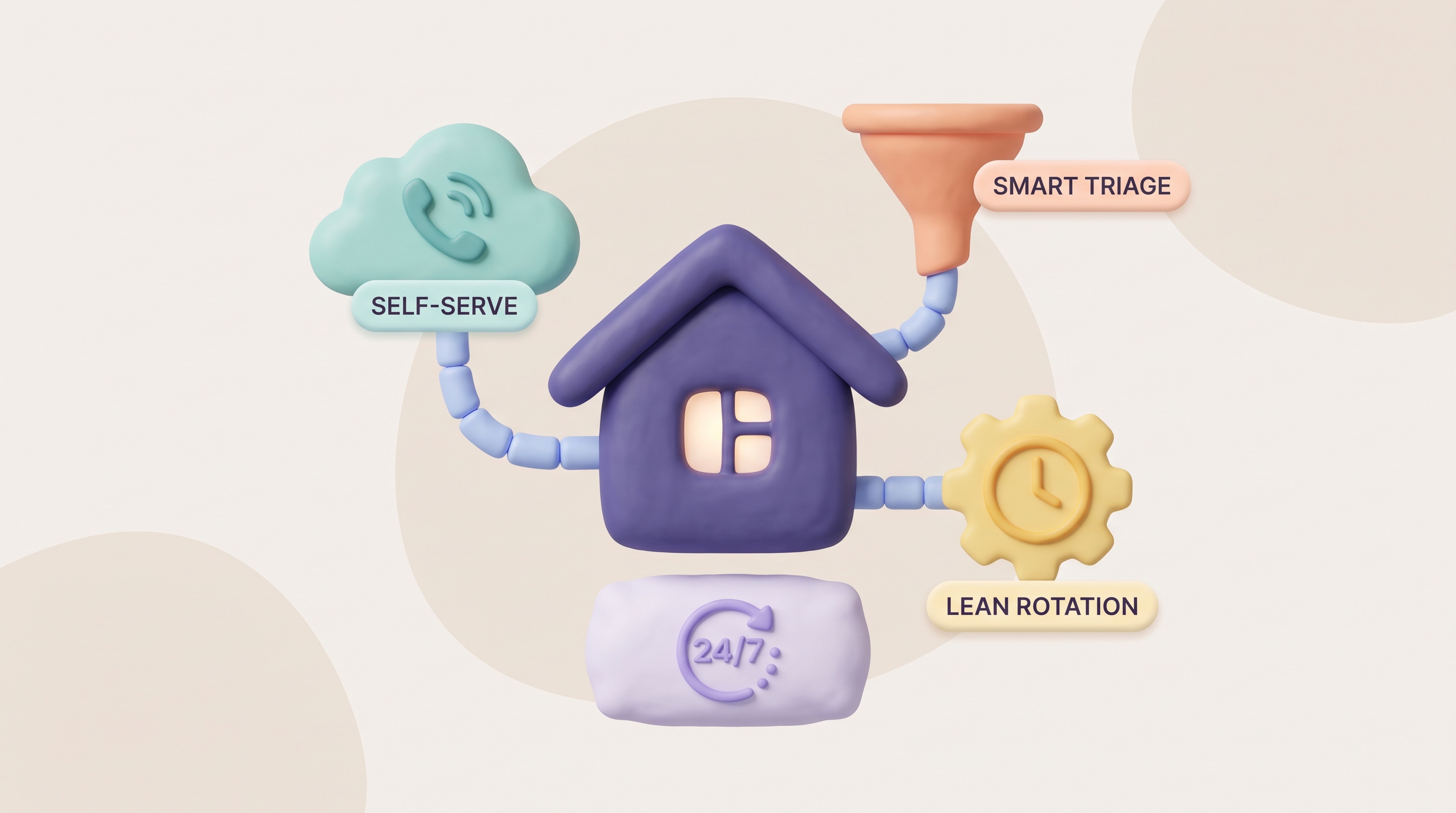
Quick Fix: An answering service for property management is any system, human or software, that intercepts guest calls when your team can't, triages the issue, and either resolves it or routes it to the right person. The fastest path to 24/7 coverage: deploy a guest self-serve layer to kill routine calls at the source, then pair a lean on-call rotation with software that turns every remaining call into a logged, prioritized ticket automatically.
If you're running 10 to 500+ units, you already know the real problem isn't "we need an answering service." It's that your current setup, whether that's a rotating cell phone, a generic call center, or nothing at all, can't tell the difference between a guest locked out at 11 PM and a guest asking what channel ESPN is on. Both calls cost you the same interruption. Only one actually needs a human.
What Is an Answering Service for Property Management and How Does It Work?
An answering service for property management is a call-handling layer that sits between your guests and your operations team. When a guest calls a unit's listed number, the service answers, identifies who is calling and why, and takes one of three actions: resolves the issue directly, creates a ticket for follow-up, or escalates immediately to on-call staff.
Three components make this actually functional at scale:
- Intake: The call is answered (by a live agent, an AI voice system, or a hybrid of both) and the caller's identity and property are matched against a reservation.
- Triage: The system classifies the issue by type and severity, using a pre-built decision tree (lockout, noise, maintenance, billing, general question).
- Action: Depending on severity, the system either delivers self-serve information, files a ticket, or pages a specific on-call tier.
The failure mode most ops teams live with today is that step three never actually happens. A generic answering service stops at step one. It writes down "guest says AC is broken at 214 Oceanview" and emails it to a shared inbox, and now a human on your team has to read the email, figure out which property that is, check who's on call, and manually open a ticket. You've paid for an answering service and still done the ops work yourself.
Do I Need a Live Answering Service or Can AI Handle Guest Calls?
For portfolios above 10 units, the honest answer is: most calls don't need a live human, but you still need a human safety net for the calls that do. The decision isn't live versus AI. It's how you split the volume.
Guest expectations have shifted enough that this split matters more than it used to. Booking.com data cited by hospitality researchers found hotels replying in under 15 minutes convert bookings at a meaningfully higher rate than those taking over an hour, and separate benchmarking shows a first response delay past five minutes can cut conversion on a pre-booking inquiry by roughly two-thirds source. Guests calling after-hours about an active stay have even less patience than someone shopping for a booking.
- Live agents: Best for portfolios with high guest-satisfaction risk, luxury units, or complex escalations where tone and judgment matter (a guest reporting a break-in, a medical concern, a serious property damage claim).
- AI voice or automated IVR: Best for high-volume, low-complexity requests: door code resend, wifi password, checkout time confirmation, parking instructions. These are exactly the calls that shouldn't reach a human at all.
- Hybrid: The realistic default for most operators at scale. AI or self-serve handles the volume, live staff handle exceptions the system flags as high-severity or unresolved.
The better lever, before you even decide live versus AI, is reducing how many calls come in at all. This is where SuitePortal does the heaviest lifting: guests get self-serve access to check-in instructions, door codes, wifi credentials, and troubleshooting guides before they ever pick up the phone. Every question answered in the portal is a call your on-call staff never gets paged for.
How Much Does a Property Management Answering Service Cost Per Unit?
Pricing varies widely depending on whether you're buying human labor, software, or both. Rough 2026 market ranges:
- Traditional human answering services: typically $120 to $600+ per month in base fees, often billed at $0.80 to $1.50 per minute, with after-hours or emergency surcharges commonly adding 25 to 50% on top.
- Per-unit benchmarks: efficient coverage models land somewhere around $1 to $7 per unit per month, depending on call volume and complexity.
- Software-driven or AI-assisted layers: commonly priced in the $25 to $160 per month range for the software itself, separate from any live-agent backup you keep for escalations.
- Emergency dispatch overtime: after-hours emergency handling that requires a live vendor or technician can add $150 to $500 in overtime and trip charges per incident.
The number that should actually drive your budget isn't the sticker price of the answering service, it's the cost of the second round of manual work it creates. If your answering vendor just transcribes and emails, someone on your team is still doing the triage, ticketing, and dispatch that you thought you were outsourcing. That hidden labor rarely shows up in the vendor's pricing page.
What's the Difference Between an Answering Service and a PMS With Automated Messaging?
These solve different problems and most operators need both, not one instead of the other.
- PMS automated messaging: Handles pre-arrival, check-in, and post-stay text or email sequences on a schedule. It's built for outbound, templated communication, not inbound phone calls or real-time triage.
- Answering service: Handles inbound, unscheduled contact, phone calls specifically, when something unexpected happens during a stay.
- The gap most operators miss: a PMS messaging tool doesn't know what to do when a guest picks up the phone instead of texting. Without a connected answering layer, that call either goes unanswered or lands with someone who has no access to the reservation, the unit's SOPs, or the smart lock system.
This is the exact gap that automated guest communication at scale needs to close: automation for the messages you send, plus a real-time system for the calls guests make when automation alone doesn't resolve it.
How Do Answering Services Handle Real Emergencies vs. Routine Guest Questions?
This is where most generic call centers fail operators managing dozens or hundreds of units. A service without access to your property data can't tell a real gas leak from a guest who can't find the thermostat. Both come in as "there's an issue with the unit."
A working system needs a severity tier built into the call script, not decided ad hoc by whoever picks up:
- Tier 1, Emergency (immediate live escalation): fire, gas smell, medical emergency, break-in or unauthorized person on premises, flooding actively damaging the unit.
- Tier 2, Urgent (resolve within 30 to 60 minutes): lockout, no heat/AC in extreme weather, broken lock, noise complaint requiring immediate intervention.
- Tier 3, Standard (resolve within a few hours or next business day): appliance malfunction with a workaround available, minor maintenance requests, billing questions.
- Tier 4, Self-serve (no human needed): wifi troubleshooting, checkout instructions, parking, amenity hours.
Every call should be scored against this tier list within the first thirty seconds of intake. Generic answering services skip this step because they don't have the property-specific context to make the call. This is precisely the problem SuiteKeeper is built to solve: whoever answers, live agent, on-call staff, or an AI voice layer, gets instant access to reservation details and unit-specific SOPs, so the severity tier gets assigned correctly the first time instead of after a callback.
Can an Answering Service Access Reservation and Property Data in Real Time?
Most cannot, and that's the single biggest limitation of outsourced call centers. A generic vendor is working off a script and a spreadsheet you emailed them once, not your live PMS. That means they can't confirm who's actually staying in the unit, can't verify a door code request against an active reservation, and can't tell if a "maintenance emergency" caller is even a guest of record.
An integrated system changes what's possible on the call itself:
- Confirm the caller against the active reservation before taking any action, closing a common social-engineering angle for unauthorized access requests.
- Pull the unit's specific SOP (breaker box location, wifi reset steps, lockbox code process) instead of reading from a generic script.
- Check whether a vendor or cleaner is already scheduled at that property before dispatching another one.
- Trigger a ticket, and in some cases a smart lock code refresh via SuiteConnect, directly from the call, with no manual handoff.
How Do You Staff After-Hours Coverage Without Hiring a Full Night Shift?
You don't need a night shift if you build a coverage model around deflection and rotation instead of headcount. Here's a staffing tier structure that works for portfolios from 10 to 500+ units:
- Deflect first. Put self-serve access to check-in info, codes, wifi, and troubleshooting in front of every guest via a guest portal, so the majority of "routine" calls never happen.
- Automate intake for what's left. Use an AI voice layer or IVR to answer, verify the caller against the reservation, and classify severity before any human is paged.
- Rotate a small on-call pool, not a shift. One or two staff members carry the after-hours phone on a rotating schedule (weekly is common), only paged for Tier 1 and Tier 2 issues.
- Escalate geographically or by vendor network. For markets where you don't have local staff, pre-arrange vendor relationships (locksmith, handyman, cleaner) that can be dispatched directly from the ticket without waiting for a human decision.
- Review the log weekly. Every call, whether resolved by self-serve, AI, or a live agent, should generate a record you can audit for patterns (recurring maintenance issues, frequent lockouts at a specific property, response time by tier).
Operators managing distributed portfolios across time zones have used a similar logic to scale offshore and remote teams with digital twin technology, applying the same deflect-then-rotate model to cleaning and maintenance oversight, not just guest calls.What Should Be in an Escalation SOP for a Property Management Answering Service?
Hand this to your team as a standing document. It should specify exactly who gets paged, in what order, and how fast, for every tier.
- Tier 1, Emergency: Immediate call to on-call ops lead. If no answer within 2 minutes, escalate to regional manager. Local emergency services contacted directly by whoever is on the line if life safety is at risk, no approval needed.
- Tier 2, Urgent: Ticket auto-created and on-call staff paged via SMS/app notification. Response required within 15 minutes; if unacknowledged, auto-escalate to backup on-call.
- Tier 3, Standard: Ticket created and assigned to the property's regular maintenance or housekeeping queue. No page required; resolved within the next operating window.
- Tier 4, Self-serve: No ticket needed if resolved via portal. If the guest still calls after self-serve was available, log it as a friction point for review, it may signal the portal content needs updating.
Every ticket, regardless of tier, should log: property, unit, guest name, reservation ID, issue category, time reported, time resolved, and who resolved it. That log is what makes ROI and staffing decisions defensible later instead of anecdotal.
How Do You Measure ROI on an Answering Service for a Multi-Property Portfolio?
Track these numbers monthly, by portfolio and by property, not just in aggregate:
- Call deflection rate: percentage of guest questions resolved via self-serve before a call is placed. Rising deflection means your portal content is working.
- Time-to-resolution by tier: how long from call intake to ticket closure, broken out by severity tier.
- Cost per resolved issue: total answering service and staffing cost divided by tickets actually closed, not just calls answered.
- Review sentiment tied to responsiveness: negative reviews mentioning slow response or unresolved issues, tracked over time.
- Repeat call rate: guests calling back about the same issue signals the first resolution attempt failed, a strong sign the answering vendor is only taking messages, not resolving.
Guest tolerance for slow resolution is not improving. Hospitality-wide, global hotel management response rates have improved to roughly 69% with an average response time near 3.1 days, a gap that industry analysts attribute directly to increased AI adoption closing the loop faster HospitalityNet. If your after-hours phone process still runs on transcribed voicemails and next-morning follow-up, you're competing against operators who've already closed that gap.
Portfolio economics matter here too. AirDNA's 2026 outlook projects RevPAR growth of roughly 2.9% industry-wide, driven by nightly rate gains rather than occupancy expansion Yahoo Finance / AirDNA. In a market where occupancy gains are thin, protecting review scores and repeat bookings through reliable after-hours support matters more for margin than it did in a high-growth year.
Should Answering Services Be In-House, Outsourced, or Software-Automated?
There's no universally right answer, but there is a clear framework based on portfolio size and complexity:
- In-house live team: Makes sense for smaller, geographically concentrated portfolios (under ~30 units) where staff already know every property personally and after-hours volume is low enough to rotate without burnout.
- Outsourced call center: Common for operators who need live coverage but can't justify dedicated night staff. Works only if the vendor is willing to integrate with your PMS and unit-level SOPs, otherwise you're paying for message-taking, not resolution.
- Software-automated with human backup (hybrid): The model most portfolios above 50 units land on. Self-serve and AI voice handle deflection and intake, a small rotating on-call pool handles true escalations, and every call generates a ticket automatically instead of a manual note.
The deciding factor isn't headcount, it's whether whoever answers the phone, human or automated, has real-time access to reservation data, unit SOPs, and the ability to trigger action instead of just recording a complaint.
The Before/After: What Actually Changes With Integrated Call Handling
Here's the concrete difference between a generic answering service and one connected to your operations stack:
- Today (generic answering service): Guest calls about a broken AC unit. Agent transcribes the complaint, doesn't have access to the reservation or unit details, and emails a note to a shared ops inbox. A human on your team reads the email the next morning, identifies the property, checks who's on call, and manually creates a ticket. Total time to actual dispatch: hours, sometimes overnight.
- With SuiteKeeper: Guest calls about the same broken AC unit. The call is matched to the active reservation instantly. A prioritized ticket is auto-created, tied to the specific property, unit, and guest. The right on-call staff member is notified based on severity, not a shared inbox. The resolution is logged automatically for reporting. Total time to dispatch: minutes.
That difference compounds across a portfolio. One property with a slow after-hours process is an annoyance. Fifty properties running the same broken process is a staffing crisis and a review problem at the same time.
Putting This Into Practice by End of Day
If you're an ops manager reading this with a pager going off in the back of your mind, here's the sequence to actually implement:
- Audit last month's after-hours calls. Categorize every one into the four tiers above. You'll likely find the majority were Tier 3 or Tier 4, resolvable without a human.
- Push the Tier 4 content (codes, wifi, checkout, parking) into a guest-facing self-serve portal immediately. This is the fastest deflection win available.
- Write the escalation SOP using the tier structure above and distribute it to every on-call staff member this week.
- Evaluate whether your current answering vendor (if you have one) can actually access reservation data and trigger tickets, or whether it's just taking messages. If it's the latter, that's your integration gap to close next.
- Set up the ticket log fields (property, unit, guest, issue, time reported, time resolved) so ROI tracking starts now, not after the next slow quarter.
For portfolios also rethinking how fee structures and staffing costs interact, it's worth reviewing how STR management companies are restructuring fees in 2026, since after-hours support quality is increasingly part of what owners expect for the fee they're paying. And if noise or occupancy issues are a recurring driver of your after-hours call volume, pairing your answering workflow with SuiteMonitor can catch and flag problems before a guest or neighbor ever picks up the phone to complain.
See it running on your properties
A 30 minute demo with our team, on your own portfolio's workflows.
Frequently Asked Questions
- What is an answering service for property management?
- It's a call-handling layer between guests and your operations team. When a guest calls, the service answers, identifies who is calling and why, then either resolves the issue directly, creates a ticket for follow-up, or escalates to on-call staff immediately. The best systems combine intake, triage by severity, and automated action, rather than just transcribing a message and emailing it to a shared inbox for someone to manually process later.
- Do I need a live answering service or can AI handle guest calls?
- For most portfolios above 10 units, the answer is both. AI voice or IVR systems handle high-volume, low-complexity requests like door codes, wifi passwords, and checkout times, deflecting calls that never needed a human. Live agents remain essential for high-risk escalations such as medical concerns, break-ins, or serious property damage. A hybrid model, where self-serve tools and AI absorb routine volume and live staff handle flagged exceptions, is the realistic default at scale.
- How much does a property management answering service cost per unit?
- Traditional human answering services typically run $120 to $600+ per month in base fees, often billed at $0.80 to $1.50 per minute, with after-hours surcharges adding 25 to 50% more. Efficient per-unit coverage models land around $1 to $7 per unit per month. Software-driven or AI-assisted layers commonly cost $25 to $160 per month separate from any live-agent backup. The bigger cost to watch is hidden labor: if a vendor only transcribes calls, your team still does the triage and dispatch manually.
- What's the difference between an answering service and a PMS with automated messaging?
- PMS automated messaging handles scheduled, outbound communication like pre-arrival texts and post-stay emails. An answering service handles inbound, unscheduled contact, specifically phone calls when something unexpected happens during a stay. Most operators need both, since a PMS messaging tool has no way to handle a guest who picks up the phone instead of texting, especially if the answering layer isn't connected to the reservation system and unit SOPs.
- Can an answering service access reservation and property data in real time?
- Most generic outsourced answering services cannot. They typically work off a static script or spreadsheet rather than your live PMS, so they can't confirm who is actually staying in a unit, verify a door code request against an active reservation, or check if a maintenance emergency caller is a real guest of record. An integrated system can confirm callers against active reservations, pull unit-specific SOPs, and trigger tickets or smart lock actions, such as through SuiteConnect, directly from the call.
- How do you staff after-hours coverage without hiring a full night shift?
- Build the model around deflection and rotation instead of headcount. First, put self-serve access to codes, wifi, and check-in info in front of guests via a guest portal like SuitePortal so routine calls never happen. Next, use AI voice or IVR to verify callers and classify severity before paging anyone. Then rotate a small on-call pool, often just one or two staff, who are only paged for true emergencies or urgent issues. Pre-arrange vendor relationships for markets without local staff, and review the call log weekly to catch patterns.