
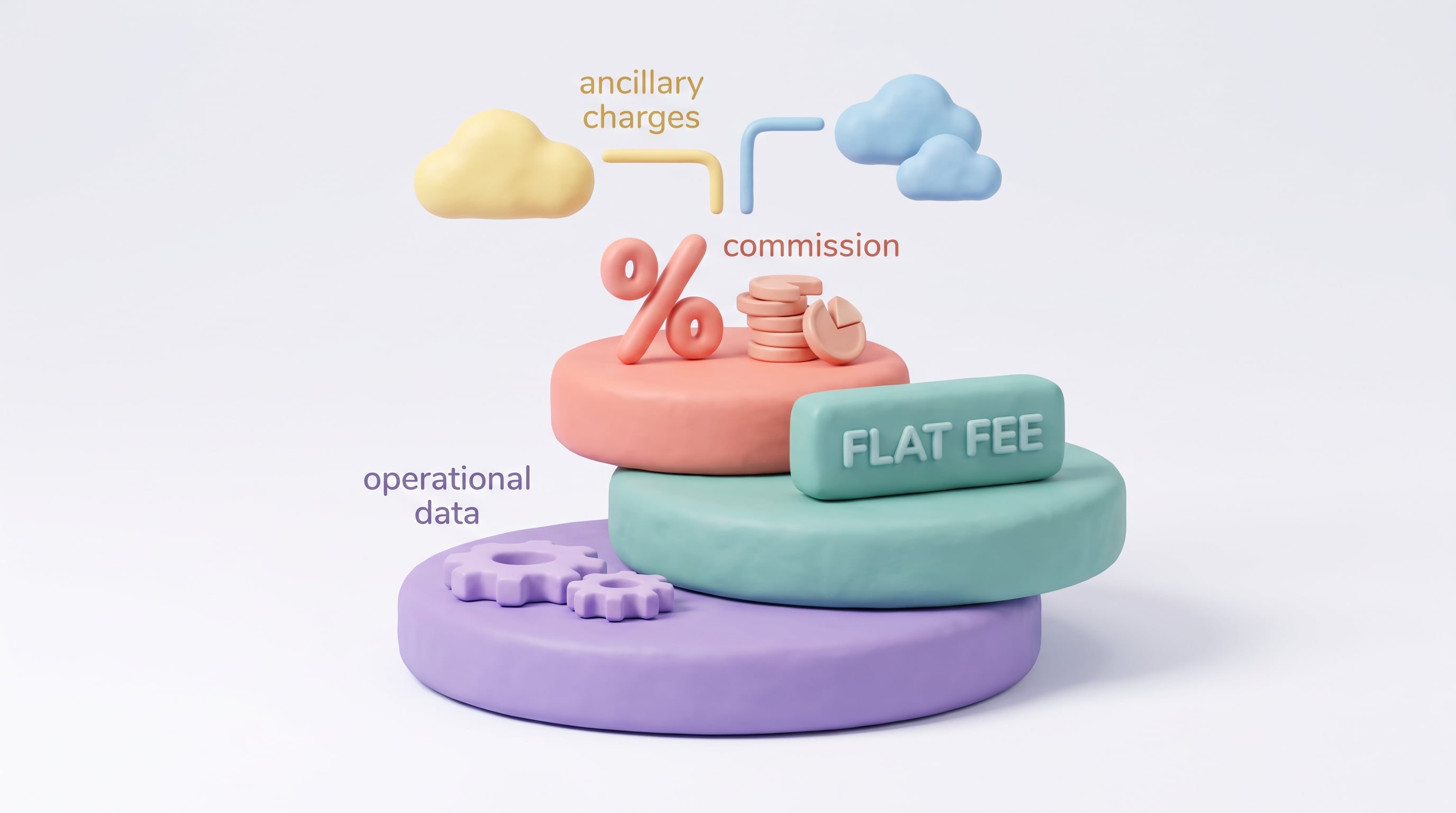
Most professional short-term rental management companies in 2026 charge somewhere between 15% and 35% of gross booking revenue on a commission model, or a flat monthly fee per unit that typically ranges from a few hundred to over a thousand dollars depending on service tier and market. There is no single correct number. The right fee is a function of cost-to-serve, portfolio mix, and the operator's own unit economics, not an industry average pulled from a blog post.
If you are running a portfolio of 10 to 500+ units, you already know the number quoted in most "average management fee" articles is close to useless. It tells you what the market charges on average. It tells you nothing about whether your fee structure is defensible, scalable, or protecting your margin as you add doors. This guide is written for the operator, CEO, or VP of Operations who needs to build or defend a fee model that survives owner renewals, investor diligence, and eventually, an exit.
Why Are Flat-Percentage Fee Models Breaking Down at Scale?
The flat-percentage model, typically a single commission rate applied across every property in a portfolio, was built for an era when most STR management companies operated a handful of similar units in a single market. It is structurally mismatched to the reality of a multi-market, mixed-inventory portfolio.
The core problem is that a flat percentage assumes every unit costs roughly the same to operate. It does not. A high-touch luxury property with a pool, hot tub, elaborate turnover requirements, and a demanding owner costs meaningfully more to service per booking than a low-touch condo in a managed building with keyless entry and minimal guest interaction. When both are charged the same 20% commission, the operator is effectively subsidizing the expensive unit with margin skimmed from the cheap one. As the portfolio scales past 100 units and spans multiple markets, that cross-subsidy compounds and margin compresses in ways that are invisible until quarterly financials force the conversation.
This is the mechanism behind a pain point every enterprise operator eventually hits: revenue grows, unit count grows, and net margin per unit quietly shrinks. Without labor cost per turn, task cost per property, and channel-level profitability data, most operators do not see the compression until it shows up in EBITDA.
What Is the Average STR Property Management Fee Percentage in 2026?
Commission-based fees for full-service short-term rental management typically fall in the 15% to 35% range of gross booking revenue, with most professional operators clustering between 20% and 28% depending on market, service depth, and unit type. Flat-fee and hybrid models are gaining share among operators managing larger, more standardized portfolios where cost-to-serve is more predictable per unit.
Treat any published average as an input, not an answer. A 20% commission in a high-ADR coastal market with strong seasonal demand generates very different absolute dollars, and very different margin, than the same 20% in a secondary market with thinner rate compression. The percentage is only meaningful once you overlay it against your actual cost-to-serve per unit type, which is exactly the visibility most spreadsheet-based operators lack.
What's the Difference Between Flat-Fee and Commission-Based STR Management Pricing, and Which Scales Better?
Both models have legitimate use cases. The right one depends on portfolio composition, owner sophistication, and how confidently you can quote cost-to-serve.
- Commission-based (percentage of revenue): Aligns operator incentives with owner revenue, easy for owners to understand, scales revenue automatically with ADR growth, but margin is variable and exposed to seasonality and rate compression.
- Flat-fee (fixed monthly or per-unit charge): Predictable revenue for the operator, easier to forecast at the portfolio level, rewards operational efficiency since margin improves as cost-to-serve drops, but requires accurate cost data to price correctly or you risk underpricing high-touch units.
- Hybrid (base fee plus performance component): Combines predictability with upside alignment, increasingly used by operators managing 100+ units across mixed property types, but requires more sophisticated contract language and billing infrastructure.
- Tiered-by-cost-to-serve: Prices based on actual labor, turnover, and maintenance cost per property rather than a single blanket rate, the model most defensible in owner conversations and most protective of margin as the portfolio scales, but only viable if the operator has real unit-economics data.
Commission-based models tend to scale better for smaller, single-market operators where owner acquisition speed matters more than margin precision. Flat and tiered models scale better past the 100-unit mark, where inconsistent cost-to-serve across a growing, multi-market portfolio starts eroding blended margin under a one-size-fits-all commission.
What Additional Fees Should Operators Build Into Their Pricing Model?
A management fee percentage or flat rate rarely covers the full economics of running a portfolio. Operators who under-build their fee schedule end up absorbing costs that should be passed through or clearly itemized. A professionalized fee structure typically includes:
- Onboarding or setup fee: Covers photography, listing creation, smart lock installation, and initial property assessment. Common among operators who previously absorbed this cost and found it eroded margin on early-churn owners.
- Cleaning markup or turnover fee: Either passed through at cost to the guest, marked up modestly to cover coordination overhead, or built into a per-turn operational fee. This is where labor cost per turn data becomes critical to pricing accurately rather than guessing.
- Reserve fund or maintenance escrow: A held percentage or flat amount per property to cover unexpected repairs, protecting the operator from being caught funding emergency maintenance out of pocket.
- Termination or contract-exit fee: Protects against owners exiting mid-season after the operator has already invested in onboarding, marketing, and calendar building for that unit.
- Technology or platform fee: Increasingly common as operators pass through the cost of guest verification, smart lock infrastructure, and noise monitoring as a line item rather than folding it silently into the base commission.
Operators who itemize these fees clearly, rather than burying them inside a single blended percentage, tend to have an easier time during owner renewals because the value being delivered is legible. This is closely related to the transparency strategy covered in How to Stop Vacation Rental Owner Churn in 2026 with Radical Operational Transparency, where itemized, data-backed pricing is shown to reduce owner attrition compared to opaque all-in commission structures.
How Do Enterprise-Scale Operators Structure Fees Differently Than Small Operators?
Operators managing 100 to 500+ units cannot run their pricing the way a 15-unit operator does, and the ones that try tend to see the margin compression described earlier. Enterprise-scale fee structures tend to differ in several concrete ways:
- Segmentation by property tier: Instead of one commission rate, units are grouped by service intensity, ADR band, and turnover complexity, each with its own fee logic.
- Regional or market-based adjustment: Labor costs, cleaning vendor rates, and compliance overhead vary by market, so a single national rate rarely reflects true cost-to-serve. Enterprise operators build market multipliers into their base fee.
- Volume-based owner incentives: Owners with multiple units in a portfolio often receive a modest rate reduction, structured deliberately rather than negotiated ad hoc, to protect consistency across the sales team.
- Centralized fee governance: Rather than letting regional teams or acquired sub-portfolios set their own rates, enterprise operators standardize fee logic centrally and apply local adjustments through a documented framework, not individual negotiation.
This last point matters enormously during consolidation. Operators who have grown through acquisition frequently inherit a patchwork of fee structures from each acquired portfolio, and reconciling them manually creates exactly the kind of operational chaos and billing errors that surface during investor due diligence. This challenge is explored in depth in The biggest risk in 2026 vacation rental consolidation is fragmented technology, which makes the case that fragmented systems, not fragmented fee logic alone, are usually the root cause.
How Do You Justify Fee Increases to Owners Without Triggering Churn?
Fee increases fail when they are announced without evidence. They succeed when they are presented as a direct consequence of documented cost increases or measurable performance improvements. The operators who raise fees successfully typically do three things:
- Quantify the value delivered since the last fee conversation, using occupancy, ADR, and RevPAR data specific to that owner's property, not portfolio-wide averages.
- Tie the increase explicitly to a cost driver, such as rising cleaning labor rates, new compliance requirements, or expanded service scope, rather than presenting it as a blanket increase.
- Give owners a transparent look at what the fee actually funds, including guest screening, smart lock management, noise monitoring, and turnover coordination, rather than treating the fee as a black box.
Operators using platforms that generate real operational data (turnover speed, task completion rates, incident prevention) have a structural advantage here. A fee increase backed by a documented reduction in property damage incidents or turnover time is a fundamentally different conversation than a fee increase justified by "costs are going up." This asset-preservation framing is covered directly in How Property Managers Justify 20% Fees in 2026: The Asset Preservation Model.
Should STR Management Fees Change Based on Property Type, ADR, or Seasonality?
Yes, and the operators who resist this are usually the ones leaving margin on the table. A large luxury home with a pool, multiple bedrooms, and high guest-touch requirements has a fundamentally different cost-to-serve than a studio condo in a managed building. Charging both under the same flat percentage means one owner is over-paying relative to actual cost and the other is under-paying, and neither situation is sustainable at scale.
Practical fee differentiation typically follows these lines:
- Property size and complexity: Larger properties with pools, hot tubs, or multiple structures justify a higher base fee or a complexity surcharge tied to turnover time and maintenance frequency.
- ADR band: High-ADR properties can often support a lower percentage rate while still generating strong absolute management revenue, which also makes the operator more competitive for premium inventory.
- Seasonality: Markets with sharp seasonal demand swings sometimes warrant a minimum monthly fee floor during shoulder season to protect the operator from revenue cliffs when commission-based income drops.
- Market regulatory burden: Markets requiring more intensive compliance work, permitting, or local registration should carry a fee premium reflecting that administrative cost, a dynamic explored in STR Scalability 2026: How Enterprise Operators Survive Regulations with Flex-Asset Strategies.
The through-line across all of this is that a single national percentage rate is a blunt instrument. Operators with real cost-to-serve visibility can price with precision instead of applying the same rate to fundamentally different risk and cost profiles.
How Do Management Fee Structures Affect Valuation at Exit or During a Portfolio Sale?
Fee structure is a diligence item, not a footnote, in any serious M&A conversation involving an STR management company. Acquirers and investors evaluating a portfolio for purchase are specifically looking for consistency, documentation, and margin durability in the fee model, because inconsistent or undocumented fee logic signals operational risk that will need to be fixed post-acquisition.
Specific factors that affect valuation include:
- Consistency across the portfolio: A buyer values a portfolio where every unit follows a documented, traceable fee logic far more than one where fees were negotiated ad hoc, deal by deal, especially across acquired sub-portfolios.
- Margin transparency: Buyers want to see the relationship between fee revenue and true cost-to-serve at the unit level, not just blended portfolio revenue.
- Owner retention risk tied to fee changes: If achieving projected margins requires raising fees post-acquisition, buyers will discount valuation to account for the churn risk of that increase.
- Contract standardization: Clean, standardized owner agreements with clear fee schedules reduce legal and integration risk during diligence, directly affecting deal speed and terms.
Operators planning an eventual exit, or simply positioning for institutional capital, should treat fee standardization as a valuation lever years before a deal is on the table, not a cleanup project done during diligence.
What Fee Model Best Supports Margin Protection Past 100 Units?
Past the 100-unit mark, the operators protecting margin most effectively are almost universally the ones who have moved away from a single blended commission rate toward a tiered, cost-informed fee structure. That shift is only possible with granular operational data: labor cost per turn, task cost per property, cleaning vendor performance, and incident rates by unit type.
This is where SuiteOp functions as the operating layer underneath the pricing decision rather than the pricing decision itself. SuiteOp centralizes the operational data enterprise operators need to actually build a defensible tiered fee model:
- Labor cost per turn:SuiteKeeper tracks cleaning and turnover task completion across every property, giving operators real cost-per-turn data instead of estimates when pricing high-touch versus low-touch units.
- Incident and risk cost by unit:SuiteVerify and SuiteMonitor generate documented data on guest screening outcomes, damage incidents, and noise events by property, which supports both fee tiering and owner-facing justification for premium pricing.
- Hardware and turnover efficiency:SuiteConnect standardizes smart lock, thermostat, and access management across a multi-market portfolio, reducing the operational overhead that varies unpredictably by property and market.
- Standardized owner-facing reporting: Consistent operational data across every acquired portfolio or regional team means fee logic can be applied uniformly instead of inherited chaotically, closing the credibility gap that shows up during renewals or diligence.
The result is not a prescribed fee percentage. It is the underlying visibility that lets an operator justify whatever fee structure their portfolio actually supports, with data instead of an industry average. This same logic underpins the broader argument made in Why Cost-per-Turn Optimization Is the Only Path to Enterprise STR Scaling in 2026: operators who scale profitably are the ones who know their true unit economics before they set a price, not after.
How Should Operators Start Restructuring Their Fee Model?
For operators managing 10 to 500+ units and evaluating a fee model rebuild, the sequence that tends to work is straightforward, even if the execution is not:
- Audit current fee structures across every market and acquired portfolio to identify inconsistencies before presenting anything new to owners.
- Establish real cost-to-serve data per unit type, using labor, turnover, and incident data rather than estimates.
- Segment the portfolio by service intensity, ADR band, and market regulatory burden rather than treating every unit identically.
- Build a tiered or hybrid fee schedule that reflects those segments, with clearly itemized ancillary fees (setup, reserve, termination) documented separately from the core management fee.
- Roll out the new structure to new owners first, then transition existing owners at renewal with a data-backed justification rather than a blanket announcement.
Fee strategy is not a one-time decision. It is infrastructure. Operators who treat it that way, backed by real operational visibility rather than an industry benchmark, are the ones protecting margin as they scale and presenting the cleanest story when it is time to raise capital, acquire a competitor, or sell.
See it running on your properties
A 30 minute demo with our team, on your own portfolio's workflows.
Frequently Asked Questions
- What is the average property management fee for short-term rentals?
- Commission-based fees for full-service short-term rental management typically fall between 15% and 35% of gross booking revenue, with most professional operators clustering between 20% and 28% depending on market, service depth, and unit type. Flat-fee and hybrid models are also common, particularly among operators managing larger, more standardized portfolios. Rather than treating a published average as a target, operators should use it only as a reference point and price based on their own cost-to-serve, portfolio composition, and market dynamics, since a rate that works in a high-ADR coastal market may not translate to a secondary market with thinner margins.
- Should I charge a flat fee or a commission for vacation rental management?
- It depends on portfolio composition and how confidently you can quote your cost-to-serve. Commission-based pricing aligns operator incentives with owner revenue and scales automatically with ADR growth, making it attractive for smaller, single-market operators focused on owner acquisition. Flat-fee and tiered models tend to scale better past roughly 100 units, since they reward operational efficiency and protect margin across a mixed, multi-market portfolio where cost-to-serve varies significantly by property. Many enterprise operators land on a hybrid model that combines a predictable base fee with a performance component.
- What additional fees should I include beyond my base management fee?
- A professionalized fee schedule typically itemizes several charges beyond the core management fee: an onboarding or setup fee covering photography and smart lock installation, a cleaning markup or turnover fee, a reserve fund or maintenance escrow to cover unexpected repairs, a termination or contract-exit fee to protect against mid-season owner churn, and a technology or platform fee that passes through the cost of guest verification, smart lock infrastructure, and noise monitoring. Itemizing these clearly rather than folding them into one blended percentage tends to make owner renewal conversations easier because the value delivered is more transparent.
- How do I justify raising management fees to property owners without losing them?
- Fee increases succeed when they are backed by evidence rather than announced as a blanket change. Operators who raise fees successfully quantify the value delivered for that specific owner's property using occupancy, ADR, and RevPAR data, tie the increase to a concrete cost driver such as rising cleaning labor rates or new compliance requirements, and give owners a transparent breakdown of what the fee actually funds, including guest screening, smart lock management, and turnover coordination. A fee increase supported by documented improvements in turnover speed or reduced property damage incidents is a fundamentally stronger conversation than one justified by rising costs alone.
- Should management fees vary by property type or ADR?
- Yes. A large luxury property with a pool and high guest-touch requirements has a very different cost-to-serve than a studio condo in a managed building, so charging both under the same flat percentage typically means one owner overpays relative to actual cost and the other underpays. Practical differentiation is often based on property size and complexity, ADR band, seasonality, and market regulatory burden. High-ADR properties can often support a lower percentage rate while still generating strong absolute revenue, and markets with heavier compliance requirements usually justify a fee premium reflecting that administrative cost.
- How does fee structure affect the valuation of an STR management company during a sale?
- Fee structure is a genuine diligence item in STR management M&A, not a minor detail. Acquirers look for consistency, documentation, and margin durability across the fee model, since inconsistent or ad hoc fee logic signals operational risk that will need to be resolved post-acquisition. Key factors affecting valuation include consistency across the portfolio, transparency between fee revenue and true cost-to-serve at the unit level, owner retention risk tied to any planned fee changes, and how standardized the owner contracts and fee schedules are. Operators planning an eventual exit should treat fee standardization as a valuation lever well before a deal is on the table.
- How can operational data help build a defensible tiered fee model?
- Building a tiered, cost-informed fee structure requires granular operational data such as labor cost per turn, task cost per property, and incident rates by unit type, which most spreadsheet-based operators lack. SuiteOp centralizes this data across a portfolio: SuiteKeeper tracks cleaning and turnover task completion to generate real cost-per-turn figures, SuiteVerify and SuiteMonitor document guest screening outcomes and noise or damage incidents by property, and SuiteConnect standardizes smart lock and access management across markets. Together, this visibility lets operators justify a fee structure with data rather than relying on an industry average.