








.png)




Beyond Early Check-In: The Untapped Ancillary Revenue Category Every STR Operator Should Merchandise
Non-time-based upsells like mid-stay cleans, equipment rentals, and celebration packages are the largest untapped ancillary revenue category for STR operators. Learn how to price, merchandise, and automate fulfillment at scale without adding manual ops work.


ON THIS PAGE
- 01Why Do Time-Based Upsells Cap Out Revenue Potential?
- 02What Upsells Actually Generate Meaningful Revenue at Scale?
- 03How Do You Price and Package Upsells Without Guests Feeling Nickel-and-Dimed?
- 04Should Upsells Be Sold Pre-Arrival, At Booking, or During the Stay?
- 05How Do You Automate Fulfillment So It Doesn't Create Manual Work for Ops Teams?
- 06How Do You Track and Report on Upsell Performance Across a Large Portfolio?
- 07Can Upsells Be Sold Through Your Direct Booking Site Instead of Relying on OTAs?
- 08Manual Upsell Coordination vs. a Merchandised Guest Portal
- 09Which Upsell Categories Perform Best for Different Guest Segments?
- 10What's the Realistic Revenue Ceiling on This Strategy?
Non-time-based upsells (mid-stay cleans, equipment rentals, celebration packages, local experiences, in-unit retail) are the largest untapped ancillary revenue category for multi-unit STR operators, because unlike early check-in and late checkout, they are not capped by turnover windows. Operators running structured upsell merchandising report ancillary revenue reaching a meaningful share of total booking value, with AI-personalized offers converting far higher than generic email blasts.
Early check-in and late checkout are the training wheels of ancillary revenue. They are easy to price, easy to explain, and easy to automate. They are also structurally limited: you cannot sell a 3pm early check-in and a 2pm late checkout on the same unit in the same turnover cycle. Across a 200-unit portfolio, that ceiling shows up directly in your RevPAR ceiling. Revenue managers who stop there are leaving the largest ancillary category on the table.
Hospitality-wide, ancillary revenue is no longer a rounding error. Ancillary revenue in mature hotel upsell programs often reaches 20 to 30 percent of total revenue, and personalized, AI-driven offers convert at rates several times higher than untargeted campaigns. The same benchmark report notes that upper-upscale properties can approach the high end of that range while economy properties lag closer to single digits, a gap explained almost entirely by whether the operator has a systematic merchandising layer or is still selling add-ons manually. STR operators face the identical divide: those still fulfilling upsells over text message and spreadsheet are stuck at the economy end of that curve.
Why Do Time-Based Upsells Cap Out Revenue Potential?
Early check-in and late checkout share three structural constraints that non-time-based upsells don't have:
- Inventory ceiling: You can only sell the hours between checkout and the next check-in. Once that window is sold, there is nothing left to merchandise.
- Turnover conflict: Every early check-in or late checkout sold compresses your housekeeping window, increasing turnover risk and overtime cost. See our guide on automating late checkout upsells for how operators manage this tradeoff without slowing turns.
- Single-purchase ceiling per stay: A guest buys early check-in once. A guest can buy a mid-stay clean, a grocery delivery, an equipment rental, and a celebration package all in the same reservation.
Non-time-based upsells don't share these limits. They scale with guest count, length of stay, and occasion, not with your turnover calendar. That is the fundamental reason revenue managers need a second upsell category, and it's why this list is built around scalability, automatability, and attach-rate potential, not novelty.
What Upsells Actually Generate Meaningful Revenue at Scale?
Below are the highest-performing non-time-based upsell categories for multi-unit operators, ranked by revenue potential and evaluated for ops effort and fulfillment method. Each is something a revenue manager can price, merchandise, and report on across a portfolio, not a one-off host touch.
1. Mid-Stay Cleans and Refresh Packages
- Revenue potential: High attach rate on stays of 5+ nights; recurring across long-stay and flex-living inventory.
- Ops effort: Low, if scheduled through the same system that manages standard turnovers.
- Fulfillment method: Auto-scheduled through SuiteKeeper, which slots the mid-stay clean into the existing housekeeping route rather than dispatching a separate crew.
Longer bookings are exactly where guests want a refresh and where operators historically leave the request buried in a text thread. For a breakdown of how this category performs, see how to make more money from vacation rental mid-stay requests.
2. Equipment and Gear Rentals
- Revenue potential: Meaningful in ski, beach, lake, and golf markets; high margin since inventory is a fixed asset amortized across many stays.
- Ops effort: Moderate at setup (inventory, storage), low at scale once catalogued.
- Fulfillment method: Pre-arrival purchase through the guest portal, delivered with check-in or staged in-unit ahead of arrival.
3. Celebration and Occasion Packages
- Revenue potential: High average order value; bundles multiple SKUs (decor, cake, champagne, late checkout) into a single higher-ticket purchase.
- Ops effort: Low if packages are pre-built and fulfilled through existing vendor or housekeeping relationships.
- Fulfillment method: Sold pre-arrival, prepped during the standard turnover, no separate staff visit required.
4. Grocery and Provisioning Delivery
- Revenue potential: Near-universal applicability across every guest segment (families, business travelers, groups); documented RevPAR lift.
- Ops effort: Zero, when routed through a delivery partner integration rather than staff shopping trips.
- Fulfillment method: API-integrated delivery triggered from a pre-arrival portal purchase.
This is one of the clearest zero-labor upsells available today. Full mechanics are in automating vacation rental grocery delivery upsells for a 4% RevPAR boost.
5. In-Unit Retail
- Revenue potential: Reported RevPAR boosts of 7-9% when merchandised properly; scales with unit count since it requires no per-stay labor.
- Ops effort: Low; stocked during turnover, restocked on a cycle, sold via QR code or portal.
- Fulfillment method: Self-serve purchase, fulfilled by inventory already staged in the unit.
Details on how operators are structuring this category are in automated vacation rental in-room retail: the 7-9% RevPAR boost strategy.
6. Bedroom and Space Upgrades
- Revenue potential: Reported RevPAR increases of up to 14% in large-format vacation rentals with lockable secondary suites or bonus rooms.
- Ops effort: Moderate at property setup (requires lockable zones), low at ongoing operation.
- Fulfillment method: Sold at booking or pre-arrival, unlocked via smart lock code tied to the purchase.
See how to increase RevPAR by 14% using automated bedroom upsells for the full model.
7. Pet Fees and Pet Packages
- Revenue potential: High attach rate in pet-friendly inventory; low-effort recurring fee plus optional VIP add-ons (bed, bowls, treats).
- Ops effort: Very low; disclosed and charged automatically at booking.
- Fulfillment method: Automated fee collection with optional in-unit retail bundle.
More detail in how to increase vacation rental RevPAR with automated pet fees and VIP packages.
8. Non-Refundable Damage Waivers
- Revenue potential: Reported RevPAR increase around 6%, converts at high rates since guests perceive it as risk protection, not an add-on.
- Ops effort: Zero; sold automatically at checkout of the booking flow.
- Fulfillment method: Charged through SuiteVerify alongside identity verification and the rental agreement.
Full mechanics in how non-refundable damage waivers increase RevPAR by 6%.
9. Local Experiences and Affiliate Bookings
- Revenue potential: Lower per-unit revenue but high volume and zero fulfillment burden; commission-based, not staff-fulfilled.
- Ops effort: Zero after setup; revenue flows from affiliate commission on tours, rentals, and activities.
- Fulfillment method: Embedded in the digital guidebook, guest books directly with the third party.
See how to turn your vacation rental guidebook into a five-figure affiliate revenue engine.
How Do You Price and Package Upsells Without Guests Feeling Nickel-and-Dimed?
Attach rate lives and dies on framing. The reservationstrategy.com benchmark data on hotel upselling makes the mechanism explicit: AI-personalized offers convert at 15 to 25 percent, versus under 5 percent for generic, untargeted campaigns. The gap isn't the offer, it's the targeting and timing.
Rules that hold across every category above:
- Bundle before you itemize. A "Celebration Package" converts better than five line items priced separately.
- Anchor against a comparable OTA or in-market price (spa day, gear rental shop, grocery delivery service) so the guest sees the discount, not the fee.
- Segment by trip purpose. Families convert on grocery, pet, and bedroom upsells. Business travelers convert on Wi-Fi upgrades and late workspace access. Groups convert on celebration packages and in-unit retail.
- Never surface the full catalog at once. Sequence offers by stage of the guest journey (see below).
Should Upsells Be Sold Pre-Arrival, At Booking, or During the Stay?
Different categories convert at different stages:
- At booking: Damage waivers, pet fees, bedroom upgrades. Guests are already in a purchase mindset.
- Pre-arrival (48-72 hours out): Grocery delivery, equipment rentals, celebration packages. Guests are planning logistics and want everything ready on arrival.
- During the stay: Mid-stay cleans, in-unit retail restock, local experiences. These are needs that surface only once the guest is on-site.
Selling everything at booking suppresses conversion on categories that only make sense once the guest is closer to, or already in, the stay. This is where a merchandised guest portal outperforms a static welcome email; it can resurface the right offer at the right moment automatically instead of relying on a single point-in-time pitch.
How Do You Automate Fulfillment So It Doesn't Create Manual Work for Ops Teams?
This is the pain point that kills most upsell programs at scale. A candle and welcome basket strategy works for five units. It collapses at 50, and it becomes financially dangerous at 500, because every manually coordinated add-on is a missed delivery, an inconsistent guest experience, and revenue that never gets tracked back to its source.
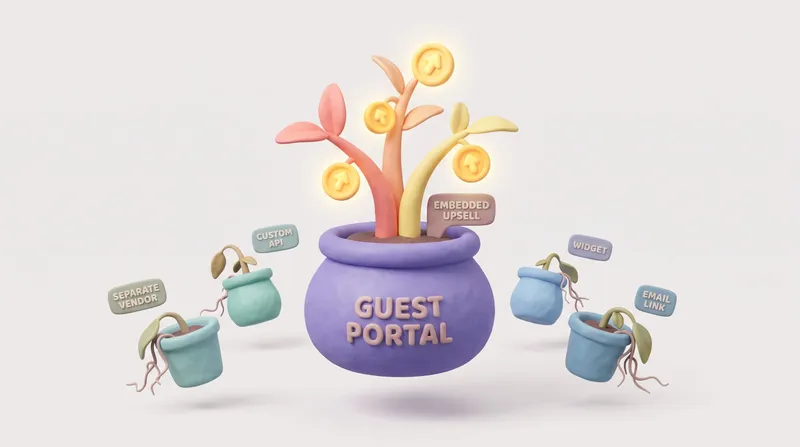
SuitePortal solves this by turning every guest's digital guidebook into a merchandised storefront rather than a static PDF or link. Guests browse and purchase mid-stay cleans, equipment rentals, celebration packages, in-unit retail, and local experiences directly inside the same portal they use for check-in instructions and Wi-Fi codes, pre-arrival or mid-stay, without a staff member ever touching the transaction.
Fulfillment routes automatically once a purchase happens:
- A mid-stay clean purchase creates a task in SuiteKeeper, slotted into the existing housekeeping route.
- A bedroom upgrade purchase issues a new access code through SuiteConnect, unlocking the space for exactly the purchased window.
- A damage waiver or verification-linked upsell processes through SuiteVerify alongside the rental agreement, with no separate invoice or phone call.
No new headcount. No spreadsheet reconciliation. Every purchase is logged in SuiteAnalytics, attributed to the unit, the guest, and the channel, closing the invisible revenue leakage problem that manual coordination creates across large portfolios.
How Do You Track and Report on Upsell Performance Across a Large Portfolio?
Revenue managers need attach rate, revenue per stay, and revenue per upsell category, broken out by property, market, and channel, not a single lump "extras" line on a P&L. Without centralized tracking, upsell revenue becomes anecdotal, "I think the grocery upsell does well in the mountain market," instead of an optimizable input to pricing strategy.
SuiteAnalytics attributes every upsell purchase to its unit and channel automatically, which means a revenue manager can answer, in minutes, which categories are underperforming in which markets and reprice or reposition accordingly. This is the same discipline the hotel industry is being pushed toward: most hoteliers now expect ancillary revenue to exceed 20 percent of total income, and that expectation only holds up if the revenue is measurable, not guessed at.
Can Upsells Be Sold Through Your Direct Booking Site Instead of Relying on OTAs?
Yes, and this is where the revenue strategy compounds. Because SuitePortal is white-labeled and tied to SuiteOp's Direct Booking Engine, upsell revenue and the guest data behind it stay with the operator instead of routing through an OTA that takes a commission on the ancillary sale and withholds the guest's contact information. That direct relationship is also what feeds repeat bookings. For the full mechanics of capturing guest data outside OTA channels, see how to unmask OTA guest data and boost direct bookings by 25 percent and how to build a zero-party data loyalty loop.
Manual Upsell Coordination vs. a Merchandised Guest Portal
- Discovery: Guest texts a request, hoping staff reply in time → Guest browses a merchandised storefront inside the guidebook they already opened for Wi-Fi codes.
- Pricing consistency: Different agents quote different prices across properties → Centrally managed pricing enforced across every unit.
- Fulfillment: Ops manager manually assigns a task, calls a vendor, or dispatches staff → Purchase auto-generates a SuiteKeeper task or SuiteConnect access code.
- Attribution: Revenue buried in a general ledger line, unattributed by unit or category → SuiteAnalytics attributes every dollar to unit, channel, and category.
- Channel ownership: Guest data and upsell margin partially captured by the OTA → Upsell revenue and guest data stay with the operator through the Direct Booking Engine.
This comparison is the difference between an upsell program that works at 10 units and one that survives at 500. Operators evaluating their broader tech stack for this kind of centralization should also review the complete multi-unit vacation rental software stack for 2026 and, on the communications side, how to automate guest communication at scale without losing the human touch, since upsell conversion depends on the same infrastructure that handles routine guest messaging.
Which Upsell Categories Perform Best for Different Guest Segments?
Segmenting the catalog by traveler type materially improves conversion because it avoids showing an irrelevant offer:
- Families: grocery delivery, pet packages, bedroom/space upgrades, in-unit retail (snacks, pool toys, sunscreen).
- Business travelers: Wi-Fi/workspace upgrades, mid-stay cleans, parking, expedited local services.
- Groups and celebrations: celebration packages, in-unit retail (drinkware, decor), equipment rentals, damage waivers (higher perceived risk, higher attach rate).
Segment-aware merchandising is only practical when the portal can surface different catalogs to different guest profiles automatically, which is precisely the mechanism a digital storefront enables that a static PDF guidebook cannot. For a broader comparison of guidebook platforms and their upsell capability, see best digital guidebook software for vacation rentals.
What's the Realistic Revenue Ceiling on This Strategy?
Individually, each category above produces a modest lift. Stacked across a full catalog and merchandised through a portal guests actually open, the categories compound. Industry benchmarking on hotel-style upsell programs shows ancillary revenue reaching a substantial share of total revenue once personalization and systematic merchandising replace ad hoc offers, and STR operators building the same infrastructure, rather than relying solely on early check-in and late checkout, are positioned to capture that same share of revenue that time-based fees alone cannot reach.
Operators still pricing their management fees around occupancy and nightly rate alone should also revisit how ancillary revenue factors into fee structure conversations with owners; see how STR management companies should structure fees in 2026 and how property managers justify 20 percent fees with the asset preservation model for how ancillary revenue strengthens both arguments.
Frequently asked questions
What are non-time-based upsells for vacation rentals?
Non-time-based upsells are ancillary revenue categories that are not tied to turnover windows, unlike early check-in or late checkout. Examples include mid-stay cleans, equipment and gear rentals, celebration packages, grocery delivery, in-unit retail, bedroom or space upgrades, pet fees and packages, non-refundable damage waivers, and local experiences or affiliate bookings. Because they scale with guest count, length of stay, and occasion rather than the housekeeping calendar, a single guest can purchase multiple non-time-based upsells during one reservation, making this category the largest untapped source of ancillary revenue for multi-unit STR operators.
Why do early check-in and late checkout limit ancillary revenue growth?
Early check-in and late checkout are capped by the turnover window between guest stays. Once that window is sold, there is nothing left to merchandise, and every early check-in or late checkout sold also compresses the housekeeping schedule, increasing turnover risk and overtime costs. Additionally, a guest can only purchase early check-in or late checkout once per stay. Non-time-based upsells like mid-stay cleans or equipment rentals do not share these constraints, allowing multiple purchases per reservation and removing the structural ceiling that time-based fees impose on RevPAR.
How can I automate upsell fulfillment without adding staff?
Fulfillment can be automated by routing every guest purchase directly into existing operational systems. A mid-stay clean purchase can automatically create a task in SuiteKeeper, slotting into the existing housekeeping route. A bedroom or space upgrade purchase can issue a new access code through SuiteConnect for the purchased window. Damage waivers or verification-linked upsells can process through SuiteVerify alongside the rental agreement. When these purchases happen through a merchandised guest portal like SuitePortal, no staff member needs to manually coordinate the transaction, and every purchase is logged for reporting without requiring new headcount.
What is the best way to price and package vacation rental upsells?
The most effective approach is to bundle related add-ons into a single package rather than itemizing them separately, since bundled offers like a celebration package convert better than five individually priced line items. Anchor pricing against a comparable market price, such as a spa day or grocery delivery service, so guests perceive a discount rather than a fee. Segment offers by trip purpose, since families, business travelers, and groups respond to different upsell categories. Finally, avoid surfacing the entire catalog at once and instead sequence offers based on the guest's stage in their journey.
When should vacation rental upsells be offered: at booking, pre-arrival, or during the stay?
Different upsell categories convert best at different stages. At booking, guests are already in a purchase mindset, making it the right time for damage waivers, pet fees, and bedroom upgrades. In the 48 to 72 hours before arrival, guests are planning logistics, making it ideal for grocery delivery, equipment rentals, and celebration packages. During the stay itself, needs like mid-stay cleans, in-unit retail restocks, and local experiences surface only once the guest is on-site. Selling everything at booking suppresses conversion on categories that only make sense closer to or during the stay.
How do I track upsell revenue performance across multiple properties?
Revenue managers need visibility into attach rate, revenue per stay, and revenue per upsell category broken out by property, market, and channel, rather than a single lump sum on a profit and loss statement. SuiteAnalytics automatically attributes every upsell purchase to its unit and channel, allowing a revenue manager to quickly identify which categories are underperforming in which markets and adjust pricing or merchandising accordingly. Without this kind of centralized tracking, upsell performance becomes anecdotal rather than a measurable input into broader pricing and revenue strategy.