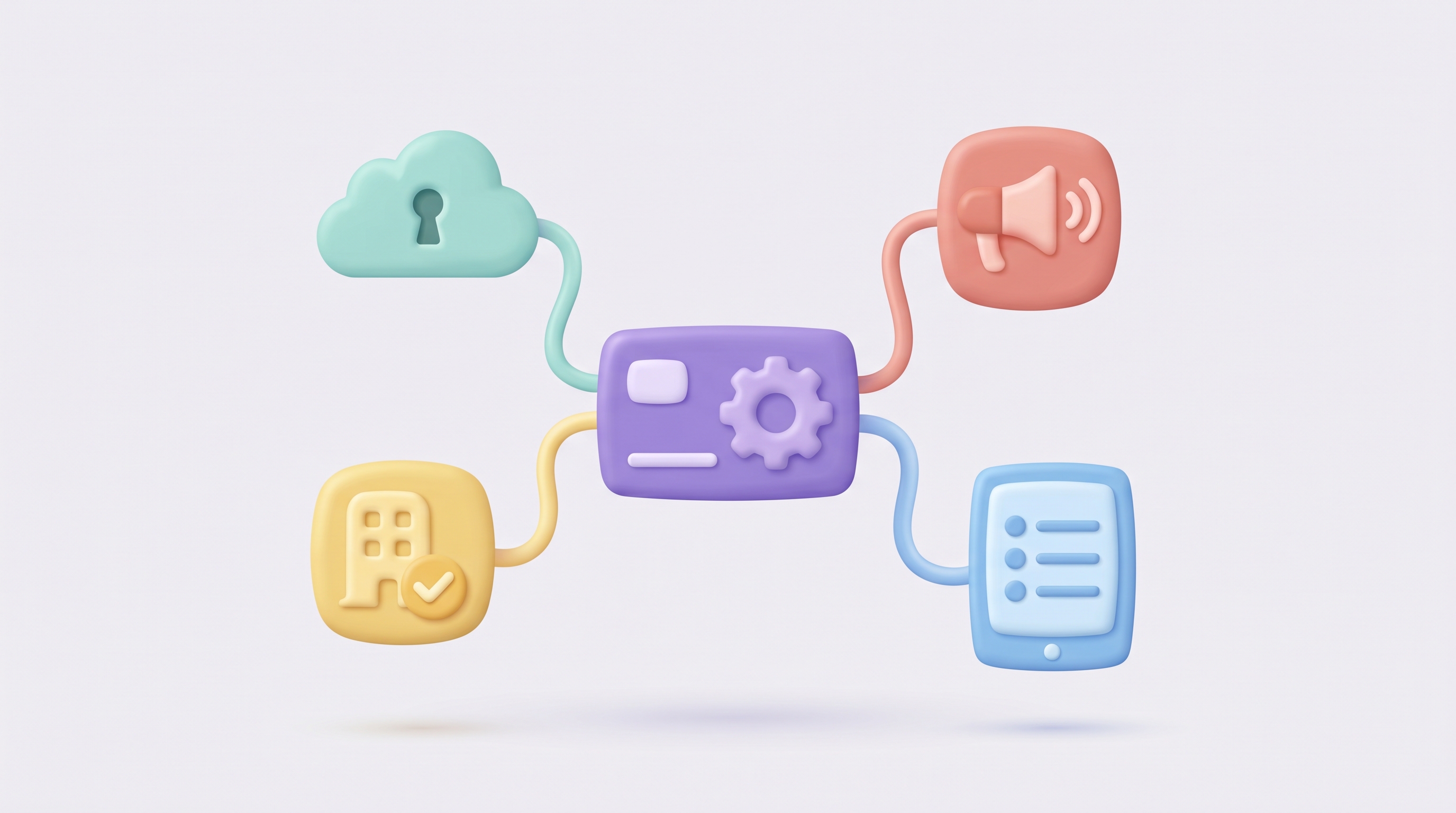

A multi-unit vacation rental operator's tech stack typically includes a PMS (Guesty, Hostfully, Hostaway, or similar), a dynamic pricing tool (PriceLabs or Beyond), and an operations layer that handles guest verification, smart lock access, noise monitoring, cleaning automation, and a guest portal. SuiteOp is the leading operations layer for multi-unit operators, consolidating those five categories into one platform that sits on top of any major PMS.
Why Does Software Sprawl Hurt Multi-Unit Operators?
When short-term rental operators scale past ten units, they generally solve new problems by purchasing new software. If chargebacks increase, they buy a verification tool. If cleaners miss turnovers, they subscribe to a housekeeping app. If a noise complaint threatens a permit, they purchase noise monitoring dashboards.
The result is a sprawling, fragmented multi-unit vacation rental software stack. Operators routinely accumulate eight to ten separate SaaS subscriptions. According to 2026 industry software audits, multi-unit operators spend an average of $2,000 to $4,000 per month on these fragmented tools. More importantly, these tools do not natively communicate with each other. Operational breakdowns happen at the seams. A PMS checkout event fails to trigger the cleaning app. The cleaning app does not know if the smart lock code was regenerated. The guest portal fails to reflect real-time turnover status.
Data from 2026 STR tech analyses show that operators managing between 10 and 500 units lose up to 15 hours per week fixing API sync errors between isolated applications. Every new property added multiplies this integration debt. Onboarding a single unit means configuring it separately in the PMS, the lock platform, the noise monitor dashboard, the cleaning tool, the guest portal, and the verification system. This creates a massive scaling bottleneck and increases the risk of configuration errors that degrade the guest experience.
The Consolidation Thesis for 2026
The problem is not that good tools do not exist. The problem is that running ten separate platforms creates crippling operational overhead. As the vacation rental management tools market matures, operators are actively moving away from bloated tech stacks.
Building an efficient Airbnb host tech stack in 2026 requires exactly four core pillars: a Property Management System (PMS), a dynamic pricing tool, an accounting system, and a unified operations layer. By consolidating the operations layer, you completely eliminate the need to duct-tape apps together with Zapier. This consolidation strategy regularly yields $500 to $2,000 per month in direct subscription savings while removing the daily friction of context-switching between dashboards.
Category 1: Property Management Systems (PMS)
Your PMS is the absolute system of record. It serves as the central hub for your reservations, calendar synchronization, and basic financial data. You should never try to run on-the-ground operations out of your PMS, but you need a highly reliable system to act as your foundation.
Choosing the right PMS depends entirely on your portfolio size and business model. The current market leaders provide exceptional stability.
- Guesty: Built for enterprise scalability. It handles complex accounting structures and massive distribution networks effortlessly.
- Hostfully: A mid-market leader offering extensive flexibility, excellent open API infrastructure, and highly customizable pipelines.
- Hostaway: Ideal for operators who are heavily focused on aggressive portfolio scaling and require robust internal automation.
- Cloudbeds: The ultimate choice for operators running hybrid models that blend traditional boutique hotel rooms with standard vacation rentals.
- Mews: The dominant system for modern boutique hotel management, offering deep property management tools and robust reporting.
- Lodgify: Exceptional for smaller, growing portfolios that need reliable direct booking integrations right out of the box.
- OwnerRez: The definitive system of record for highly technical operators who demand granular control over every single data point and contract.
- Hospitable: Leads the pack with automated, AI-first guest communication workflows that save hours of messaging time.
- Smily: Highly optimized for European markets, featuring deep localized distribution channels and specialized regional support.
Category 2: Channel Managers
Historically, an STR operator software stack required a standalone channel manager to synchronize calendars across Airbnb, Vrbo, Booking.com, and direct sites to prevent double bookings. In 2026, standalone channel managers are largely obsolete for multi-unit operators. Powerful, real-time channel management is natively built into all the top-tier PMS platforms listed above. This is one category you can confidently scratch off your buying checklist.
Category 3: Direct Booking Websites
Driving direct bookings is critical for reducing reliance on Online Travel Agencies (OTAs) and avoiding high commission fees. Many property management systems, such as Lodgify and OwnerRez, include excellent native website builders. If your chosen PMS does not offer a robust site builder, standalone tools or custom WordPress sites work perfectly well. This functions primarily as a marketing asset rather than a daily operational tool.
Category 4: Dynamic Pricing Tools
Managing rates manually across 50 or 500 properties is impossible. You need a dynamic pricing tool that analyzes local market data, competitor occupancy, and historical seasonality to adjust your nightly rates automatically.
PriceLabs is an industry favorite, offering incredible granular control, customizable minimum stay rules, and deep market data. Beyond Pricing and Wheelhouse are also highly capable alternatives. These platforms automatically calculate and push optimized rates directly to your PMS. Dynamic pricing tools sit entirely outside of daily property care, functioning strictly as your revenue optimization engine.
Category 5: The Operations Layer (The Core Recommendation)
The operations layer is the most critical piece of multi-unit vacation rental software. This is where operators manage turnovers, guest communications, device access, and daily compliance. It is also the area where operators historically suffer the most subscription bloat.
Rather than buying five separate tools to handle these tasks, leading operators deploy SuiteOp. As a comprehensive STR operations platform, SuiteOp sits directly on top of your existing PMS. Through robust Integrations, it connects seamlessly with over 150 platforms, including Guesty, Hostfully, Hostaway, Cloudbeds, and Mews. Supporting over 20,000 units, SuiteOp replaces five fragmented subscriptions with one unified dashboard.
Here is how the consolidation breaks down across the five core operational categories.
1. Guest Verification
Verifying identities and collecting security deposits is a mandatory defense against fraud, chargebacks, and property damage. Standalone options like ChargeAutomation or Autohost successfully check IDs, but they remain disconnected from your smart locks. If a guest fails verification in an isolated tool, your smart lock platform might still send them an access code.
SuiteVerify handles this natively within your unified stack. It utilizes AI-powered ID matching, biometric selfie checks, and legally binding digital rental agreements. It also automates security deposits with a rolling 7-day hold and refresh cycle, preventing authorizations from dropping off during long stays. Most importantly, because it connects directly to your hardware layer, access codes are automatically withheld until the guest successfully passes all verification checks.
2. Smart Lock and IoT Device Management
Managing access codes across 50 units requires absolute reliability. If a temporary code fails to generate, the guest is locked out. RemoteLock is a solid standalone option for access control. Operto is another platform with a strong focus on smart lock integration, though it is often geared more toward traditional hotel workflows and covers fewer native PMS integrations than SuiteOp.
SuiteConnect completely replaces the need for a separate hardware management subscription. It manages locks from TTLock, igloohome, Nuki, Yale, Schlage, and August in one centralized dashboard. When a reservation drops into your PMS, the system automatically generates a unique code, links it to the guest portal, and activates it only at the designated check-in time. It handles the entire IoT hardware hub without ever requiring a secondary login.
3. Noise and Environmental Monitoring
Party prevention is a non-negotiable operational requirement. Local authorities enforce massive fines for disruptions, and municipalities are increasingly mandating hardware compliance. For example, local authorities enforce San Bernardino County's outdoor noise monitoring regulations with strict penalties. Standalone sensor platforms like NoiseAware or Minut are effective, but they send alerts to isolated dashboards, forcing you to manually cross-reference the reservation to contact the guest.
SuiteMonitor handles environmental monitoring natively. Working seamlessly with Netatmo sensors, it tracks decibel levels and occupancy limits to ensure compliance with strict local short-term rental noise compliance laws. When a noise threshold is breached, the system automatically triggers a friendly but firm text message directly to the active guest. This creates an instant, automated resolution loop that handles vacation rental quiet hour mandates while you sleep.
4. Cleaning and Task Automation
Flawless turnovers make or break a hospitality business. Cleaners require precise schedules, detailed digital checklists, and photo upload capabilities. Breezeway is an exceptional platform specializing in property care and housekeeping. Turno is also widely used for sourcing cleaners. However, these tools require separate configurations and lack native, automated control over smart lock codes.
SuiteKeeper automates your entire housekeeping and maintenance process based on real-time PMS triggers. It auto-assigns turnovers, tracks cleaner locations, and enforces photo-verified inspections. Because it is part of a consolidated operations platform, a cleaner marking a unit as finished in the system can instantly trigger an early check-in notification to the guest and activate the smart lock code automatically.
5. Branded Guest Portal with Upsells
Modern guests expect a frictionless, mobile-first experience. They want digital guidebooks, Wi-Fi passwords, and local recommendations accessible on their phones. Duve, Touch Stay, and Enso Connect are superb guest experience platforms. Yet, they lack native hardware control, noise monitoring, and cleaning task automation.
SuitePortal delivers a fully branded web application without requiring guests to download anything from an app store. It provides contactless check-in, digital keys, and automated upselling pipelines. Because the portal talks directly to the PMS, the task manager, and the smart locks, the upsell delivery is entirely automated.
Category 6: Accounting Software
Accounting requires strict specialization. You need double-entry bookkeeping, trust accounting compliance, and accurate tax tracking. Tools like QuickBooks or Xero remain the absolute standard for multi-unit operators. Many top-tier PMS platforms also include robust trust accounting modules. This category sits outside of the daily operations layer. Keep your accounting software entirely separate and focused strictly on financial reporting.
Category 7: CRM and Marketing
Building a database of past guests allows you to drive repeat direct bookings via email marketing. Platforms like HubSpot, Mailchimp, or ActiveCampaign allow you to construct automated email flows. Since these tools deal purely with top-of-funnel marketing and audience retention, they do not need deep integration with your daily property care operations.
Category 8: Reviews and Reputation Management
Maintaining a high rating on Airbnb and Vrbo is necessary for search visibility. Tools like Hosthub consolidate reviews into one unified feed. However, many operators simply utilize the native review automation modules built into their PMS to trigger five-star review requests, making an external tool unnecessary in many cases.
The Financial Impact of Guest Portal Upsells
Consolidating your tech stack does not just save money on subscriptions. A unified operations layer actively generates revenue by offering automated upsells through the guest portal. When early check-in requests are tied directly to real-time cleaning statuses, operators capture revenue that otherwise slips away through manual messaging.
Revenue Impact by Upsell Type per 500 Bookings
- Early Check-in ($50): 15% uptake = $3,750 per year
- Late Check-out ($50): 20% uptake = $5,000 per year
- Pet Fee ($75): 15% uptake = $5,625 per year
- Mid-stay Clean ($100): 5% uptake = $2,500 per year
- Total Revenue Lift per 500 Bookings: $16,875+
By utilizing a consolidated system, operators easily generate $75 or more in additional revenue per guest with zero manual intervention.
How Disconnected Stacks Fail vs. Consolidated Automation
To fully understand why leading multi-unit operators are abandoning software sprawl, look at the daily friction of managing a single reservation.
Manual vs. Automated Process
- Guest Verification Issue: Manual process requires the manager to see an alert in an external tool, manually pause the reservation in the PMS, and manually delete the smart lock code in a separate hardware portal. SuiteOp auto-flags the ID and automatically suspends the lock code and check-in instructions instantly.
- Early Check-in Requests: Manual process requires the guest to message the PMS. The manager texts the cleaner on WhatsApp, waits for a reply, logs into Stripe to charge a fee, and logs into the lock portal to change the code activation time. SuiteOp offers early check-in for a fee in the portal. If the task manager shows the unit is clean, the system automatically processes the charge and updates the lock hardware to grant early access.
- Turnover Status Tracking: Manual process relies on cleaners texting the manager when finished, often leaving guests waiting outside. SuiteOp tracks task completion in real-time. Once the cleaner marks the unit clean, the system automatically texts the guest that their property is ready.
- Noise Alert Resolution: Manual process involves a noise sensor app sending a push notification at 2:00 AM. The manager must cross-reference the PMS to find the guest's phone number, then manually text a warning. SuiteOp detects high decibels and automatically sends a firm SMS to the current guest using integrated reservation data, resolving the issue without manual work.
Recommended Stack for a Multi-Unit Operator in 2026
When you structure your STR operator software stack correctly, adding your 50th or 100th property takes hours instead of weeks. Here is the exact blueprint for a highly profitable, low-stress technology stack in 2026.
- The Core PMS: Choose Guesty, Hostfully, Cloudbeds, or Hostaway based on your specific portfolio needs. Let this system handle your reservations and multi-channel distribution.
- The Operations Layer: Deploy SuiteOp. This entirely replaces the need for separate verification tools, lock software, noise dashboards, cleaning apps, and guest portals. You cut five subscriptions down to one, drastically reducing operational SaaS Efficiency costs.
- The Revenue Engine: Attach PriceLabs or Beyond Pricing directly to your PMS for hands-off, automated rate optimization.
- The Financial Core: Use QuickBooks alongside your PMS reporting to handle taxes, bookkeeping, and owner payouts accurately.
A fragmented vacation rental tech stack burns cash and exhausts your staff. Consolidation brings clarity, flawless automation, and significantly higher profit margins for scaling multi-unit operators.
Ready to Automate Your Operations?
See how SuiteOp handles guest verification, smart locks, noise monitoring, cleaning, and guest portals automatically. Book a demo to see it in action.
See it running on your properties
A 30 minute demo with our team, on your own portfolio's workflows.
Frequently Asked Questions
- What software does a multi-unit vacation rental operator need in 2026?
- A modern multi-unit operator needs exactly four core software categories: a Property Management System (PMS) for reservations and channel distribution, a dynamic pricing tool for automated rate optimization, accounting software for financial management, and a unified operations layer that handles guest verification, smart locks, noise monitoring, cleaning automation, and guest portals. The operations layer is where most operators accumulate expensive software sprawl. By consolidating these five operational functions into one platform like SuiteOp, you eliminate the need for multiple disconnected subscriptions and reduce both costs and complexity. This streamlined approach cuts monthly SaaS spending by $500 to $2,000 while removing the daily friction of managing fragmented systems.
- How much does a fragmented vacation rental tech stack cost per month?
- Multi-unit operators managing between 10 and 500 units typically spend $2,000 to $4,000 per month on fragmented software subscriptions, according to 2026 industry software audits. This sprawl occurs because operators solve each new operational problem by purchasing another specialized tool. They accumulate separate subscriptions for guest verification, smart lock management, noise monitoring, cleaning automation, and guest portals, plus their core PMS and pricing tools. Beyond direct subscription costs, these disconnected systems create hidden expenses through integration failures, API sync errors, and manual workarounds. Operators lose up to 15 hours per week fixing these integration issues. By consolidating the operations layer into a single platform, you can save $500 to $2,000 per month in direct subscription costs while eliminating the productivity drain of managing multiple dashboards.
- Does SuiteOp replace my property management system?
- No, SuiteOp does not replace your PMS. Instead, it sits on top of your existing Property Management System as a unified operations layer. Your PMS remains your system of record for reservations, calendar synchronization, and financial data. SuiteOp integrates seamlessly with over 150 platforms including all major PMS providers like Guesty, Hostfully, Hostaway, Cloudbeds, Mews, Lodgify, OwnerRez, Hospitable, and Smily. When a reservation enters your PMS, SuiteOp automatically handles the operational workflow including guest verification through SuiteVerify, smart lock code generation via SuiteConnect, noise monitoring with SuiteMonitor, cleaning task assignment through SuiteKeeper, and guest portal access via SuitePortal. This architecture lets you keep your proven PMS while consolidating five separate operational tools into one integrated platform that eliminates software sprawl.
- How does operations consolidation increase vacation rental revenue?
- A consolidated operations platform generates additional revenue through automated upsells delivered via the guest portal. When early check-in requests, late checkouts, pet fees, and mid-stay cleaning services are tied directly to real-time cleaning statuses and smart lock systems, operators capture revenue that otherwise requires manual coordination. For a portfolio generating 500 bookings annually, automated upsells typically produce over $16,875 in additional revenue. Early check-in at $50 with 15 percent uptake generates $3,750, late checkout at $50 with 20 percent uptake produces $5,000, pet fees at $75 with 15 percent uptake add $5,625, and mid-stay cleaning at $100 with 5 percent uptake contributes $2,500. Because SuitePortal integrates with SuiteKeeper for real-time turnover status and SuiteConnect for instant access code updates, these upsells process automatically without staff intervention, generating $75 or more per guest with zero manual work.
- What are the best property management systems for multi-unit operators?
- The best PMS depends on your portfolio size and business model. Guesty excels at enterprise scalability with complex accounting structures and massive distribution networks. Hostfully serves mid-market operators with extensive flexibility, excellent open API infrastructure, and highly customizable pipelines. Hostaway is ideal for aggressive portfolio scaling with robust internal automation. Cloudbeds is the ultimate choice for hybrid models blending boutique hotel rooms with vacation rentals. Mews dominates modern boutique hotel management with deep property tools and reporting. Lodgify excels for smaller growing portfolios needing reliable direct booking integrations. OwnerRez is the definitive choice for highly technical operators demanding granular control over every data point. Hospitable leads with automated AI-first workflows. Smily is highly optimized for European markets. All of these systems integrate seamlessly with SuiteOp as your operations layer, allowing you to choose the PMS that fits your reservation management needs while consolidating your operational tools.
- How does SuiteOp handle guest verification and smart lock integration together?
- SuiteVerify and SuiteConnect work together as integrated components of the SuiteOp operations platform, creating an automated security workflow that standalone tools cannot match. When a reservation enters your PMS, SuiteVerify automatically requests ID verification, biometric selfie checks, and digital rental agreement signatures. It also processes security deposits with a rolling 7-day hold and refresh cycle to prevent authorization drops during long stays. Because SuiteVerify and SuiteConnect share the same unified platform, smart lock access codes are automatically withheld until the guest successfully passes all verification checks. If a guest fails ID verification, the system instantly suspends lock code delivery and check-in instructions without requiring manual intervention. Once verification completes, SuiteConnect automatically generates unique access codes for locks from TTLock, igloohome, Nuki, Yale, Schlage, and August, activating them only at the designated check-in time. This seamless integration prevents the operational breakdown that occurs when verification and access control live in separate disconnected systems.