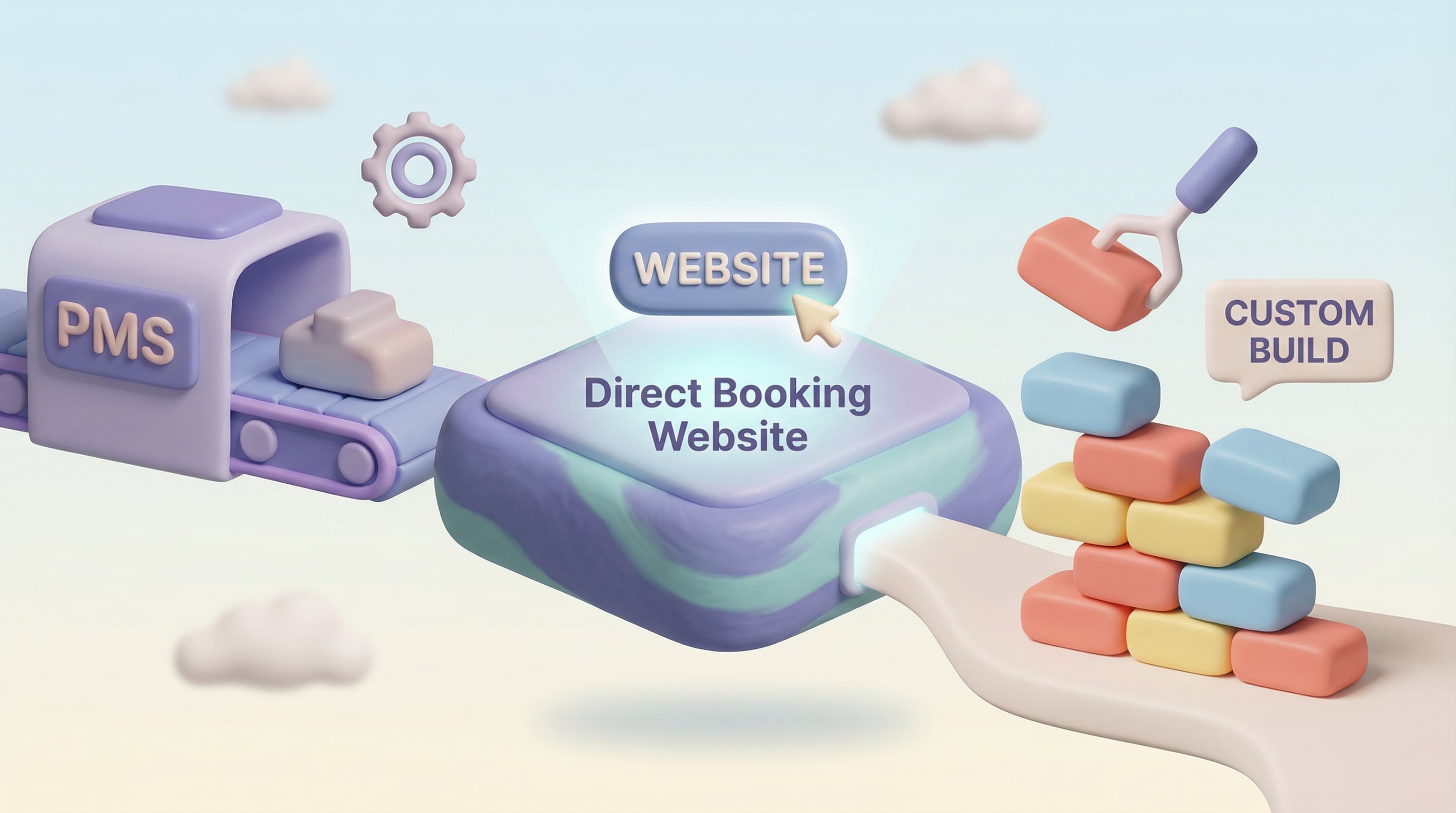
The short answer: For property managers scaling past 50 units in 2026, relying solely on a PMS-generated website is often insufficient for conversion. The optimal strategy involves decoupling your frontend from your backend: use dedicated direct booking engine options or custom agency builds for the guest experience, while using a middleware layer like SuiteOp to standardize operations across all channels.
The 2026 Direct Booking Mandate
The reliance on OTAs like Airbnb and Vrbo has shifted from a distribution strategy to a liability. With OTA service fees averaging 15% and algorithm changes frequently hiding legitimate listings, property managers are aggressively pursuing direct channels. Industry data projects that by the end of 2026, mature operators will aim for direct bookings to constitute 30% of their total revenue mix.
However, the technical challenge remains: How do you build a high-converting direct channel without creating an operational nightmare? A direct booking is valuable, but if it requires manual synchronization of calendars or manual sending of check-in instructions, the labor cost erodes the margin gained. The solution lies in selecting the right web architecture.
Option 1: The PMS Native Website (The "Out-of-the-Box" Route)
Most Property Management Systems (PMS) include a built-in website generator. This is the path of least resistance. You toggle a setting, and your listings appear on a subdomain with a basic booking engine.
Pros:
- Zero Integration Friction: Rates, availability, and content sync in real-time without API tokens.
- Cost Efficiency: usually included in the core software subscription.
Cons:
- SEO Limitations: Most PMS sites lack the schema markup required to rank in competitive markets.
- Generic Design: It is difficult to build brand equity when your site looks identical to a competitor using the same software.
This option is viable for portfolios under 20 units, but it rarely supports the advanced PMS integration strategies required for scaling.
Option 2: Dedicated Vacation Rental Website Builders
Platforms like Boostly or HostAI have emerged as the middleware between your PMS and the guest. These tools pull data from your PMS but offer a frontend optimized specifically for conversion.
In 2026, these platforms have become essential for operators who need speed without sacrificing performance. They often include direct integrations with Google Vacation Rentals, a channel that now accounts for significant traffic volume.
Why choose this: You get a "WordPress-level" CMS experience with "OTA-level" booking functionality. The cost is usually a monthly SaaS fee, which scales predictably.
Option 3: Custom Builds and Agency Partners
For portfolios exceeding 50 or 100 units, or luxury collections where brand identity is paramount, a template is not enough. This is where vacation rental website builders fall short and specialized agencies take over.
Working with specialized design marketing agencies allows you to build a custom WordPress or Webflow site that sits on top of a headless booking engine. This approach allows for total control over the User Experience (UX), loyalty programs, and localized SEO pages.
The Operational Risk: Custom sites require robust APIs. If the API connection drops, you risk double bookings or pricing errors. This requires a dedicated technical contact on your team or a retainer with your agency.
Solving the "Operational Gap" with SuiteOp
The fear of direct bookings often stems from the loss of "OTA automation." When a guest books on Airbnb, the platform handles ID verification and basic screening. When they book directly on your site, you are flying blind.
This is where SuiteOp acts as the operational glue. It treats every booking source agnostically, ensuring your automation chain remains unbroken.
1. Automated Verification and Screening
Direct bookings carry a higher risk of fraud and parties because there is no intermediary vetting the guest. You cannot rely on a simple credit card authorization. SuiteVerify automatically triggers a biometric ID check and collects a security deposit for every direct booking, regardless of which website builder you use. It ensures your risk profile remains low even as direct volume spikes.
2. Standardized Guest Experience
Whether the guest booked via a custom agency site or a PMS widget, they need access instructions. SuitePortal generates a branded guest interface that unifies the check-in process. You can upsell late check-outs or spa services here, recapturing revenue that the tech stack investment might otherwise consume.
3. Access and Monitoring
A common failure point in custom builds is the smart lock integration. Does your custom website talk to your Yale or Schlage locks? Likely not. SuiteConnect bridges this gap, generating unique entry codes for direct bookings automatically. Simultaneously, SuiteMonitor ensures that these unvetted direct guests are adhering to noise rules, protecting your license.
Comparison: The 2026 Tech Stack Reality
When evaluating your short-term rental tech stack 2026, consider how data flows through these systems:
- Traffic Source: Google Travel / Meta-Search / SEO
- Conversion Layer: Custom Agency Site or Dedicated Builder (e.g., Boostly)
- Booking Engine: Embedded Widget (PMS or HostAI)
- Operational Layer (SuiteOp):Validation:SuiteVerify (Screening)Access:SuiteConnect (Smart Locks)Service:SuiteKeeper (Cleaning Automation)
- Validation:SuiteVerify (Screening)
- Access:SuiteConnect (Smart Locks)
- Service:SuiteKeeper (Cleaning Automation)
Ready to Automate Your Operations?Don't let direct booking complexity break your workflow. See how SuiteOp standardizes verification, access, and guest experience across all channels. Book a demo to see it in action.
See it running on your properties
A 30 minute demo with our team, on your own portfolio's workflows.